
Knowing your exact age may seem simple, but calculating it precisely can become surprisingly complicated when months have different lengths, leap years are involved, or you need the result in years, months, and days rather than just years. An age calculator makes this process much easier by comparing a date of birth with a selected current or future date and presenting the difference in an understandable format.
Age is used in many everyday situations, from celebrating birthdays and completing applications to checking eligibility requirements and planning important milestones. While most people know their age in completed years, there are situations where knowing the exact duration since birth is more useful. For example, someone may want to know whether they are 25 years and 7 months old, or determine how many days remain before their next birthday.
An age calculator can provide this information quickly without requiring manual calculations. Instead of counting calendar months or remembering which years contain February 29, users can enter their dates and receive a clear result. This makes age calculation convenient for personal planning, administrative tasks, education, and many other everyday purposes.
What Is an Age Calculator?
An age calculator is a digital tool designed to determine the amount of time between two dates, most commonly a person’s date of birth and the current date. The result can usually be displayed in years, months, and days. Some calculators may also provide the total number of months, weeks, or days between the selected dates.
The basic principle is straightforward. A birth date is entered as the starting point, while today’s date or another selected date becomes the ending point. The calculator then compares the two dates while accounting for the different lengths of calendar months and variations caused by leap years. This produces a more precise result than simply subtracting one year number from another.
For example, if a person was born on March 10, 2000, and the calculation date is September 14, 2026, the result is not simply 26 years. The person is 26 years and several months old. A digital calculator can display this difference accurately and remove the need for manual calendar calculations.
How Does an Age Calculator Work?
The calculation begins with two important pieces of information: the date of birth and the date on which the age needs to be calculated. In the most common situation, the second date is the current day. Once both dates are provided, the tool calculates the elapsed calendar time between them.
The process may appear simple, but accurate calculations require attention to details. A month can contain 28, 29, 30, or 31 days, while leap years add another complication. A reliable age calculator considers these differences rather than assuming every month or year has the same duration.
The calculation can generally be understood through three stages: identifying completed years, determining the remaining months, and calculating the remaining days. If the day of the month has not yet been reached, the calculator adjusts the calculation by borrowing days from the previous month. This is one reason automated tools are often more convenient than performing the calculation manually.
Why Exact Age Matters
For everyday conversations, knowing only the number of completed years is normally enough. However, precise age can matter when a date is connected to a specific requirement or deadline. Certain applications, registrations, competitions, memberships, insurance processes, and educational programs may use age criteria based on particular dates.
An exact calculation can also be useful for personal milestones. Parents may want to track a child’s age in months and days, while adults may calculate the time remaining until a particular birthday. In some cases, people also want to compare the ages of family members or understand the exact difference between two birth dates.
Using an age calculator can therefore provide more useful information than simply saying someone is 30 or 40 years old. It can reveal the precise calendar duration and make date-based planning easier.
Age Calculation and Leap Years
Leap years are one of the most common reasons manual age calculations can become confusing. A normal year contains 365 days, while a leap year contains 366. The additional day is added to February, which normally has 28 days but has 29 days during a leap year.
A leap year generally occurs every four years, although century years require an additional rule: a century year must be divisible by 400 to qualify. This means that 2000 was a leap year, while 1900 was not.
These details are automatically handled by a properly designed age calculator. This is particularly important for people born on February 29. Since February 29 does not appear in most years, different systems and organizations may use different conventions when determining the person’s birthday in non-leap years. A calculator can perform the date comparison consistently, but legal or official age requirements should always follow the rules specified by the relevant authority.
Understanding Age in Different Formats
Age can be represented in several ways depending on the purpose of the calculation. The most familiar format is completed years, such as 18, 25, or 50. This is the format people generally use when describing their age in everyday conversations.
A more precise format expresses age in years, months, and days. For example, a result might show 32 years, 4 months, and 12 days. This format is particularly useful when someone wants to know their exact calendar age.
Some tools may also calculate the total number of days or weeks between two dates. These measurements can be useful for tracking events, projects, personal milestones, or periods of time.
| Age Format | Common Use |
|---|---|
| Years | Everyday age and general identification |
| Years, months and days | Precise personal age calculation |
| Total months | Child development and long-term planning |
| Total weeks | Certain schedules and time-based tracking |
| Total days | Detailed date-duration calculations |
The appropriate format depends on what the user needs. For most people, years, months, and days provide the best balance between accuracy and readability.
How to Use an Age Calculator Correctly
Using an age calculator is usually straightforward. The most important step is entering the correct date of birth. Even a small mistake in the day, month, or year can produce a completely different result.
A typical process involves:
- Enter the correct day, month, and year of birth.
- Select today’s date or another calculation date.
- Review the result in years, months, and days.
- Check the dates again if the result appears unexpected.
The calculation date can also be changed when users want to determine their age at a particular point in the future or past. For example, someone might calculate how old they will be on a future birthday or determine their age when a particular event occurred.
Common Uses of an Age Calculator
One of the most common uses is personal birthday planning. People can determine exactly how much time has passed since their birth and how long remains until their next birthday. This can make planning celebrations, milestones, and personal goals easier.
Age calculations are also useful for families. Parents may track children’s ages in months and days, especially during early childhood when developmental changes can happen quickly. Comparing birth dates can also help families understand the precise age difference between siblings.
In education and employment, age can sometimes affect eligibility. Certain programs have minimum or maximum age requirements, and the relevant age may need to be established on a specific date. An age calculator can help users understand their calendar age before checking the official eligibility rules.
Other uses include retirement planning, insurance-related calculations, sports categories, event registrations, and personal record keeping. However, when age has legal or contractual consequences, the organization’s official definition should always take priority over a general online calculation.
Age Calculator for Future Dates
An age calculation does not have to be limited to today’s date. Users can select a future date to discover how old they will be at a particular time. This can be useful when planning birthdays, anniversaries, education milestones, retirement targets, or other long-term events.
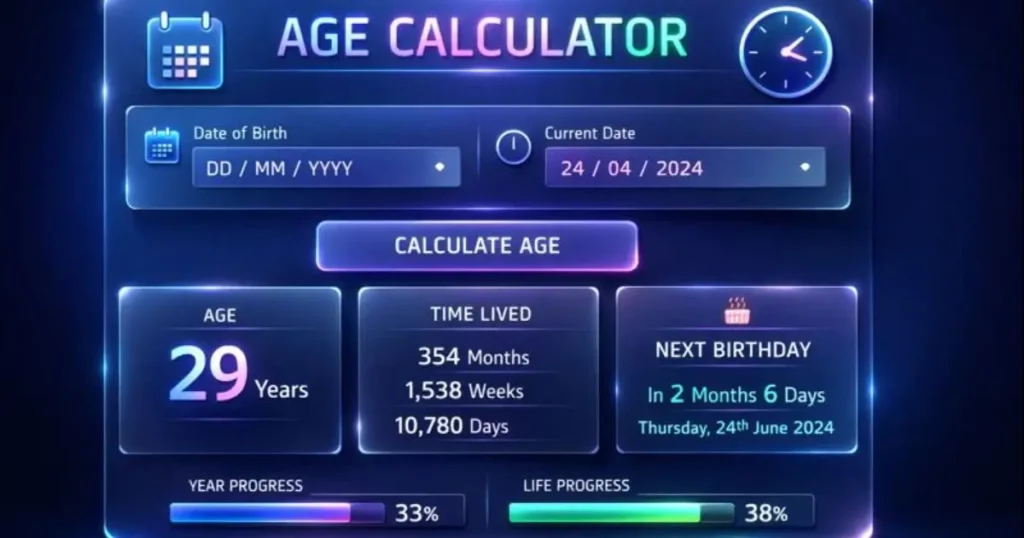
For example, someone born in 1995 may want to know their exact age on January 1, 2030. Instead of waiting until that date, they can enter the future date and receive the projected age immediately.
This feature also helps people understand upcoming milestones more clearly. Rather than thinking only in terms of a birth year, users can identify the exact number of years, months, and days between their birth date and an important future event.
Age Calculator for Comparing Two Dates
An age calculator can also be used as a date-difference tool. Instead of calculating a person’s age from birth to today, users can compare two separate dates to determine how far apart they are.
This can be useful for understanding the age difference between two people. For example, entering two birth dates can show the difference in years, months, and days. The same approach can be used to measure the duration between important personal or professional events.
However, the result should be understood as a calendar difference rather than automatically assuming that every period contains the same number of days. Calendar months and years vary in length, so a precise date-based calculation is often more meaningful than a rough day estimate.
Manual Calculation vs Digital Tools
Manual age calculation is possible, but it becomes more difficult when dates cross multiple months or leap years. Someone calculating an age by hand needs to account for the exact number of days in each month and determine whether a leap year affects the period.
Digital tools reduce this effort. A well-designed age calculator can process the dates almost instantly and present the result in a simple format. This is especially useful when users need to perform several calculations or compare different dates.
Manual calculations can still be helpful for understanding how age is determined. However, for everyday convenience and accuracy, automated date calculations are generally easier.
Tips for Getting Accurate Results
Accuracy starts with the date entered into the calculator. Users should carefully verify whether the date format is day-month-year or month-day-year, particularly when using tools designed for international audiences.
It is also important to distinguish between chronological age and an organization’s official age requirement. A person may have a particular chronological age, while an application may define eligibility based on age on a specified cutoff date. Therefore, the calculator should be treated as a calculation aid rather than a replacement for official rules.
When checking an unexpected result, users should first verify the birth date, calculation date, and date format. These simple checks can resolve most apparent errors.
The Growing Value of Simple Online Calculators
Digital calculators have become useful because they turn everyday calculations into quick, accessible tasks. Users no longer need to remember complex calendar rules or manually count days when they want an accurate result.
The value of an age calculator comes from this simplicity. It focuses on one specific task and presents information that can otherwise require several manual steps. As people increasingly manage appointments, applications, milestones, and personal records online, straightforward calculation tools can save time and reduce avoidable mistakes.
At the same time, users should understand the limits of these tools. An online calculation can tell someone the chronological difference between dates, but it cannot determine whether a particular institution considers someone eligible for a legal, financial, educational, or professional requirement. Those decisions depend on the rules established by the relevant organization.
Conclusion
An age calculator provides a convenient way to determine age accurately using a birth date and a selected calculation date. By accounting for different month lengths, leap years, and calendar differences, it can provide a result in years, months, and days without requiring complicated manual calculations. Whether someone is checking their exact age, preparing for a birthday, comparing two birth dates, planning a future milestone, or reviewing an age-based requirement, accurate date calculations can make the process easier. The most important factor is entering the correct dates and understanding what the result represents. For everyday purposes, digital age calculation tools offer a fast and practical solution.