
Knowing your exact age may sound like a simple task, but calculating it accurately can become surprisingly complicated when months, leap years, different month lengths, and specific dates are involved. Most people can quickly determine their age in years, but questions such as “How many months old am I?” or “How many days have passed since my birth?” require more detailed calculations. An age calculator app provides a convenient way to handle these calculations without manually counting dates or working through complicated calendar formulas.
Modern digital tools have made everyday calculations much easier, and age calculation is no exception. Instead of opening a calendar and counting the time between two dates, users can enter their date of birth and receive an organized result within seconds. Depending on the tool, the result may include years, months, days, total months, total weeks, total days, and even the time remaining until the next birthday.
An age calculator app can be useful for much more than checking a birthday. Students, parents, professionals, travelers, event planners, and anyone managing personal records may find accurate age calculations helpful. Understanding how these tools work and where they can provide value can make everyday date-related tasks faster and more convenient.
What Is an Age Calculator App?
An age calculator app is a digital tool designed to determine a person’s age using a birth date and a selected calculation date. In its simplest form, the user enters the day, month, and year of birth, and the application calculates the difference between that date and the current date. More advanced tools can calculate age on a specific future or past date, which makes them useful for planning and record keeping.
The main advantage is that the calculation is automated. A person does not need to remember how many days each month contains or manually account for February and leap years. The application processes the dates and presents the result in a readable format. For example, someone born on March 15, 1995, could receive an answer showing their age in years, months, and days rather than simply seeing the number of completed years.
The technology behind these tools is based on date and calendar calculations. Although the interface may look simple, accurate age calculation requires the software to correctly interpret dates and account for variations in calendar length. This is why a dedicated calculator can be more reliable for detailed calculations than trying to work everything out manually.
How Does an Age Calculator Work?
At a basic level, an age calculator compares two dates: the date of birth and the date on which the age is being calculated. The difference between these dates is then organized into meaningful units such as years, months, and days. The process becomes more complicated when the day and month of the later date occur earlier than the corresponding birth date.
For example, suppose a person was born on September 20, 2000, and the calculation date is August 10, 2026. Simply subtracting 2000 from 2026 would suggest an age of 26, but the person’s birthday has not yet occurred in 2026. Therefore, their completed age is still 25. A properly designed calculator recognizes this difference automatically.
Some tools also provide a more detailed breakdown. Instead of showing only completed years, they can calculate the precise period since birth. This allows users to understand their age in different formats, depending on what they need for personal planning, educational purposes, or general curiosity.
Why Accurate Age Calculation Matters
Age is often connected to important milestones and eligibility requirements. Certain activities, applications, registrations, competitions, examinations, travel arrangements, and official processes may depend on a person’s age on a particular date. Even a small misunderstanding about whether someone has already reached a certain birthday can lead to an incorrect assumption.
An age calculator app can reduce this uncertainty by providing a precise calculation based on the dates entered. This is particularly useful when a person needs to determine their age on a date other than today. For example, parents may want to know how old a child will be when starting school, while someone planning a future event may need to determine the age they will reach on that specific date.
Accurate calculations are also helpful when comparing ages between two people. Rather than relying on approximate differences, users can calculate the exact gap between two birth dates. This can reveal a difference of several years, months, and days, making the result more precise than a simple subtraction of birth years.
Key Features to Look for in an Age Calculator
Not every digital calculator provides the same level of functionality. A basic tool may only calculate completed years, while a more advanced application may provide several useful measurements and date-based options. Choosing the right features depends on how frequently and for what purpose the calculator will be used.
A useful age calculator app should have a straightforward interface that makes entering dates simple. Clear date fields, an easy calculation button, and readable results can make a significant difference, particularly for users who are not comfortable with complicated applications.
Other useful features may include:
- Calculation of age in years, months, and days.
- Future-age calculations for specific dates.
- Birthday countdown functionality.
- Calculation of total days, weeks, or months lived.
- Support for different date formats.
These features can turn a basic calculator into a practical date-management tool. However, simplicity remains important because the primary purpose is to provide accurate results without unnecessary complexity.
Age Calculation in Years, Months, and Days
One of the most useful capabilities of an age calculator is displaying age as a combination of years, months, and days. This format gives users a much clearer understanding of the exact time that has passed since their birth date.
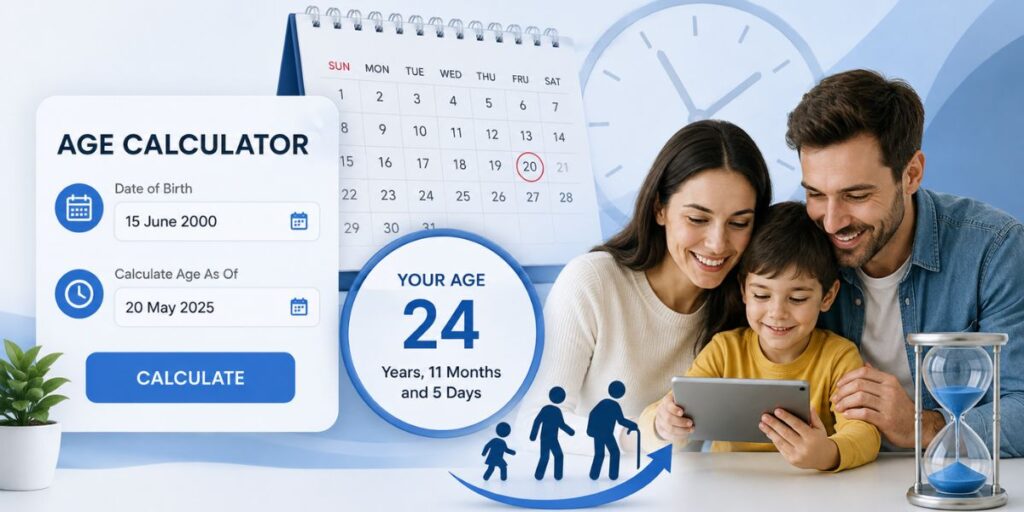
Consider someone born on January 12, 1998, with a calculation date of October 8, 2026. Their age is not simply a number of completed years. The calculator can determine the additional months and days after the last birthday, giving a more precise representation of their current age.
This detailed format can be particularly helpful when users are interested in personal milestones. Parents may want to know a baby’s age in months and days, while individuals tracking specific anniversaries may want an exact duration. The ability to switch between different measurements makes the calculation more flexible.
Understanding Different Age Formats
Age can be expressed in several ways depending on the purpose. The most common format is completed years, which is what people normally use in everyday conversations. However, digital calculators can provide additional measurements that reveal the total duration between two dates.
| Age Format | Common Use | Main Benefit |
|---|---|---|
| Years | Everyday age discussions | Simple and easy to understand |
| Years, months, days | Precise age calculation | Provides detailed information |
| Total months | Child development or planning | Useful for shorter time periods |
| Total weeks | Duration tracking | Shows elapsed time in weekly terms |
| Total days | Detailed date comparison | Gives a precise elapsed-day figure |
Each format answers a slightly different question. Someone asking “How old are you?” generally needs the number of completed years, while someone calculating the duration between two dates may benefit more from total days or months.
Using an Age Calculator for Future Dates
Age calculation does not have to be limited to the present day. Many modern tools allow users to enter a future date and determine how old they will be at that point. This can be useful for planning birthdays, anniversaries, educational milestones, and other important events.
For example, a person preparing for a major birthday may enter the event date to find their exact age on that day. Parents can also use future calculations to determine how old their children will be when reaching certain milestones. This makes the calculator useful for planning rather than simply checking current age.
Future calculations can also make long-term planning easier. Instead of estimating an age based on the calendar year, users can obtain a precise result based on the exact date. This is particularly valuable when the calculation involves dates close to a birthday.
How It Helps With Birthday Planning
Birthdays are among the most common reasons people use age calculation tools. While remembering the birth date is easy for most people, determining the exact time remaining until the next birthday can require a separate calculation.
An age calculator app can make birthday planning more convenient by comparing the current date with the upcoming birthday. Depending on its features, the tool may show the number of months, weeks, or days remaining. This can help users organize celebrations, invitations, gifts, and other preparations.
Birthday calculations can also be useful for parents. Children often care about how long remains until their next birthday, and a detailed countdown can provide a simple way to explain the remaining time. For milestone birthdays, knowing the exact date and age can also help with early planning.
Practical Uses Beyond Birthdays
Age calculations have applications in many areas of everyday life. People frequently need to determine ages for forms, applications, personal records, educational planning, and family information. Although many of these situations only require the year or completed age, having an accurate calculation can eliminate unnecessary uncertainty.
A calculator can also help people understand the difference between two birth dates. This may be useful when comparing the ages of siblings, estimating generational differences, or organizing information for personal records. Instead of manually calculating the difference, users can enter both dates and receive a clear result.
For students, age calculation can also be an interesting practical example of how mathematics and calendar systems work. Understanding why the result changes depending on the exact date can demonstrate concepts involving subtraction, time intervals, and calendar irregularities.
Common Mistakes When Calculating Age Manually
Manual age calculation seems straightforward, but several small mistakes can produce an incorrect result. One common mistake is subtracting birth years without checking whether the birthday has already occurred during the current year. This can make a person’s calculated age one year higher than their actual completed age.
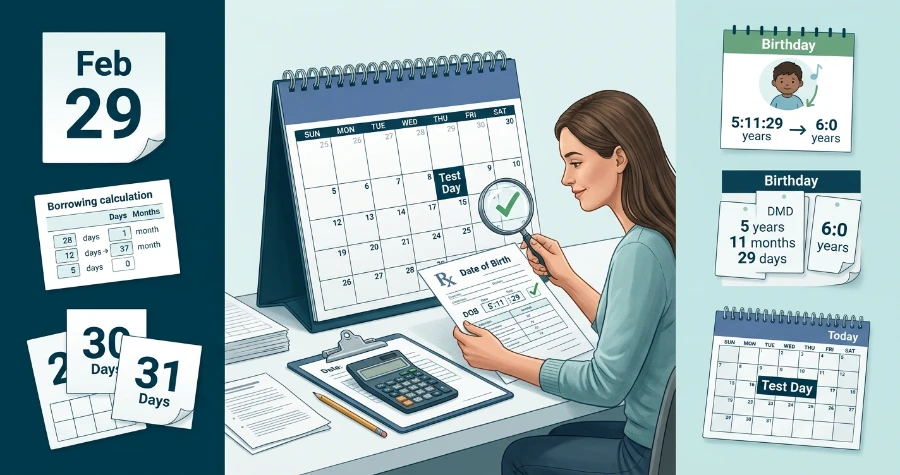
Another problem occurs when calculating months and days. Since months have different numbers of days, simply subtracting the day numbers may not always produce a valid result. February creates another complication because its length changes during leap years.
People may also forget to use the correct calculation date. Someone’s age can be different depending on whether the calculation is performed before or after their birthday. For precise results, both the birth date and calculation date must be entered correctly.
Tips for Getting the Most Accurate Result
Accuracy begins with entering the correct birth date. Users should carefully check the day, month, and year before calculating. A single incorrect digit in the year can completely change the result, while switching the day and month can also cause significant errors in systems that support multiple date formats.
It is also important to understand what the result represents. If a calculator says a person is 25 years old, this generally means they have completed 25 full years but have not yet reached their 26th birthday. If the tool provides months and days as well, those values represent the additional period since the most recent birthday.
For better results, users should:
- Double-check the birth date before calculating.
- Confirm the date format being used.
- Use the exact calculation date when precision matters.
- Review whether the result shows completed years or a detailed duration.
- Avoid treating approximate calculations as official documentation.
These simple habits can prevent most common date-related mistakes.
Privacy and Responsible Use
When using any digital tool that involves personal information, privacy should be considered. A birth date is a personal detail, and users should understand how an application handles information before entering sensitive data, especially when using unfamiliar services.
For ordinary age calculations, there is generally no reason to provide unnecessary personal information. A calculator should only require the dates needed to perform the calculation. Users should be cautious if a simple age calculation tool requests unrelated information.
Privacy becomes particularly important when calculations are performed on shared devices. Users should avoid leaving personal information visible unnecessarily and should consider whether the application stores entered dates. Choosing simple tools with transparent functionality can reduce unnecessary exposure of personal details.
The Growing Role of Digital Calculation Tools
Digital calculators have evolved from basic mathematical utilities into practical everyday assistants. People now expect quick answers for conversions, dates, percentages, finances, health-related measurements, and other routine calculations. Age calculation fits naturally into this broader trend because it involves information that people frequently need but do not necessarily want to calculate manually.
An age calculator app reflects this shift toward convenience. Instead of requiring users to understand the underlying calendar mathematics, the tool handles the calculation and presents the result in an understandable format. This makes date-based information more accessible to people of different technical backgrounds.
As digital tools continue to become more user-friendly, age calculators may also include additional features such as personalized reminders, milestone tracking, birthday notifications, and improved date comparisons. The most valuable developments will likely focus on making calculations faster while keeping interfaces simple and protecting user information.
Conclusion
An age calculator app offers a simple and practical way to determine age accurately without manually working through complicated calendar calculations. From checking a current age to calculating a future milestone, these tools can provide useful information within seconds. Their value comes from combining accuracy, convenience, and clear presentation. The usefulness of an age calculator extends beyond birthdays. It can support personal planning, date comparisons, educational activities, milestone tracking, and everyday record keeping. By accounting for different month lengths, birthdays, leap years, and exact calculation dates, digital tools can reduce the mistakes that commonly occur with manual calculations.

.jpg&description=Discover how an age calculator app makes it easy to calculate exact age, track birthdays, understand date differences, and manage important age-related dates.)