
Understanding how much energy your body needs each day can make healthy eating and weight management much easier. A person who works at a desk all day generally needs a different amount of energy than someone who spends several hours exercising or doing physically demanding work. A calorie calculator provides a convenient way to estimate these needs by considering factors such as age, sex, height, weight, and activity level. While the result is an estimate rather than an exact measurement, it can provide a useful starting point for understanding your daily energy requirements.
Calories are a measure of energy supplied by food and beverages. Your body uses this energy continuously, even when you are sleeping, because essential processes such as breathing, circulation, temperature regulation, and cell maintenance require energy. Additional energy is needed for movement, exercise, digestion, work, and everyday activities. Knowing how these components fit together can help you create more practical nutrition and fitness goals rather than relying on guesswork.
A useful approach is to view calorie information as a guide rather than a strict daily target. Individual energy requirements can change with changes in body weight, exercise habits, muscle mass, health circumstances, and lifestyle. For this reason, estimated calorie needs should be considered alongside food quality, physical activity, sleep, and overall wellbeing.
What Is a Calorie Calculator?
A calorie calculator is a tool designed to estimate the approximate number of calories a person may need during a typical day. It generally uses personal information such as age, sex, height, weight, and activity level to produce an estimated daily energy requirement. Many calculators first estimate basal metabolic rate, or BMR, and then account for physical activity to arrive at an approximate total daily energy expenditure.
The calculation is based on mathematical formulas developed from population-level research. These formulas can be useful because measuring a person’s exact energy expenditure in everyday life requires specialized equipment and controlled testing. A calculator therefore offers a practical approximation that can help people understand the relationship between their body characteristics, activity, and energy needs.
The result should not be interpreted as a perfectly precise number. Two people with the same height and weight can have different energy requirements because body composition, muscle mass, movement patterns, occupation, genetics, and other factors may differ. The purpose is to provide a reasonable reference point that can be adjusted according to real-world changes over time.
How Does a Calorie Calculator Work?
Most calorie estimation tools begin by calculating BMR. Basal metabolic rate represents the approximate amount of energy the body needs to maintain essential functions while at rest. It does not represent the total number of calories a person burns throughout the day because normal life involves walking, working, exercising, eating, and other activities.
After estimating BMR, the calculation typically considers physical activity. Someone who rarely exercises will have a lower activity-related energy expenditure than an individual who trains regularly. The resulting estimate is often referred to as total daily energy expenditure, or TDEE. It provides a broader picture of how much energy a person may use throughout an average day.
The Role of Personal Information
The information entered into a calorie calculator can substantially affect the estimated result. Age matters because average energy requirements can change over the course of adulthood. Height and body weight also influence the calculation, while activity level helps account for energy used through movement and exercise.
Sex is another variable commonly included in traditional formulas because average body composition and energy expenditure patterns differ between male and female populations. However, mathematical estimates remain approximations and do not fully capture individual physiological differences.
BMR and TDEE: Understanding the Difference
BMR and TDEE are closely related but represent different concepts. BMR describes the approximate energy required to keep the body functioning at rest. TDEE goes further by accounting for energy used during daily movement and activities. Understanding this distinction is important when interpreting calorie estimates.
For example, imagine two people with similar body measurements. One works from home, spends most of the day sitting, and rarely exercises. The other has a physically active job and participates in regular training. Their BMR estimates may be relatively similar, but their overall daily energy requirements could be considerably different because their activity levels are not the same.
A calorie calculator generally uses an activity multiplier or another method to account for this difference. Because activity descriptions can be subjective, choosing the closest realistic activity category is important. Overestimating activity can produce an unrealistically high calorie estimate, while underestimating it can produce a lower figure than expected.
Common Activity Levels and Their Meaning
Activity categories are usually designed to simplify a complicated range of daily movement. A person does not necessarily need to exercise intensely every day to have meaningful activity expenditure. Walking to work, standing for long periods, household tasks, commuting, recreational activities, and structured workouts can all contribute to daily energy use.
| Activity Pattern | General Description | Typical Lifestyle Example |
|---|---|---|
| Sedentary | Very little planned exercise | Mostly sitting with limited movement |
| Lightly active | Some regular movement | Walking or light exercise several days a week |
| Moderately active | Consistent exercise or active routine | Regular workouts combined with an active lifestyle |
| Very active | Frequent demanding activity | Intensive training or physically active work |
| Extremely active | Very high physical workload | Heavy physical work combined with substantial training |
These categories should be treated as broad descriptions rather than exact scientific measurements. Daily activity can vary significantly from one week to another, so a person’s average routine is generally more useful than a single unusually active or inactive day.
Using Calorie Estimates for Weight Management
Calorie balance is one factor involved in changes in body weight. When energy intake consistently exceeds energy expenditure, the body can store some of the excess energy, while consistently consuming less energy than the body uses can contribute to weight loss. However, real-world changes are more complicated than a simple mathematical equation because metabolism, appetite, water balance, body composition, and activity can change over time.
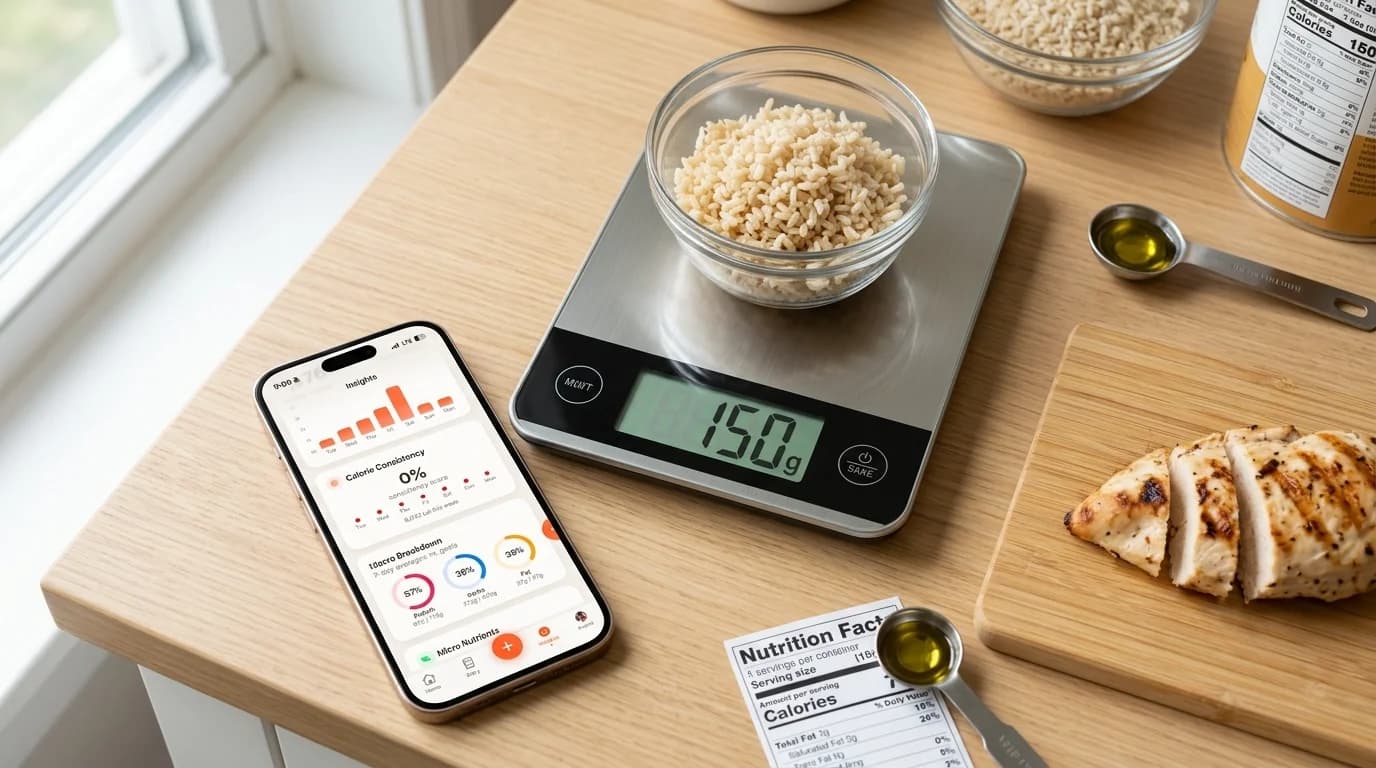
Someone trying to lose weight may use a calorie calculator to establish an estimated maintenance level and then create a moderate calorie reduction. The goal should generally be a sustainable approach rather than an extremely restrictive diet. Eating too little can make it difficult to obtain adequate nutrients and may negatively affect energy, training performance, and adherence.
For weight gain, the opposite approach may be appropriate: an individual may need to consume more energy than they regularly use. The quality of those additional calories still matters. Nutrient-dense foods containing protein, whole grains, vegetables, fruits, healthy fats, and other essential nutrients can support a more balanced eating pattern than relying primarily on highly processed foods.
How to Use a Calorie Calculator More Effectively
A calorie calculator becomes more useful when its result is treated as a starting estimate rather than an instruction. Entering accurate information is important because even small differences in height, weight, or activity classification can change the final result. It is also helpful to reassess the estimate when there are significant changes in body weight or daily activity.
Instead of becoming focused on one precise number, look at broader patterns. If a person follows a consistent eating routine and their weight remains relatively stable over several weeks, that real-world observation can provide information about their approximate energy balance. If weight changes unexpectedly, activity, food intake, sleep, stress, and other factors may all deserve consideration.
Calorie Quality Matters Too
Calories do not provide the entire picture of nutrition. Two meals can contain a similar number of calories while offering very different amounts of protein, fiber, vitamins, minerals, and other nutrients. A balanced diet should therefore focus not only on quantity but also on the nutritional value of the foods being consumed.
For example, a meal containing vegetables, legumes, whole grains, lean protein, and healthy fats can provide a combination of nutrients and help support fullness. Highly processed foods can sometimes make it easier to consume large amounts of energy without feeling equally satisfied. This does not mean individual foods need to be completely avoided; overall dietary patterns are generally more useful than labeling foods as simply good or bad.
Factors That Can Affect Daily Calorie Needs
Daily energy requirements are influenced by more than age, height, weight, and exercise. Muscle mass can affect resting energy expenditure, while changes in physical activity can alter the amount of energy used throughout the day. Even small movements, sometimes described as non-exercise activity, can contribute meaningfully to total daily expenditure.
Other circumstances can also affect nutritional requirements. Growth, pregnancy, breastfeeding, illness, recovery, and certain medical conditions can change energy needs. For these situations, a standard calculator may not provide an appropriate target without professional interpretation.
People should also recognize that calorie needs are not necessarily identical every day. A rest day may require less energy than a demanding training day, while an unusually active weekend can increase energy expenditure. Looking at patterns across time can therefore be more practical than trying to make every day’s intake match exactly.
Calorie Counting Without Becoming Overly Restrictive
Tracking calories can be helpful for some people because it increases awareness of portion sizes and eating patterns. However, it is not essential for everyone. Some people prefer to use balanced meals, hunger and fullness cues, consistent portions, and regular activity instead of recording every food item.
If calorie tracking becomes stressful or causes excessive concern about food, it may be useful to step back from detailed counting. Healthy nutrition involves more than numerical targets. Adequate protein, fiber, hydration, micronutrients, enjoyable foods, and a sustainable eating routine all contribute to a practical long-term approach.
A sensible calorie calculator can support awareness, but it should not replace attention to how the body feels or professional nutritional advice when that advice is needed.
Practical Ways to Build a Balanced Eating Routine
For people using calorie estimates to improve their diet, the next step is often creating meals that provide satisfying portions of different food groups. Including a protein source, vegetables or fruit, a source of carbohydrates, and an appropriate amount of healthy fat can create a balanced foundation.
Simple habits can also make calorie management easier without requiring constant calculation:
- Build meals around nutrient-dense foods and appropriate portions.
- Include protein and fiber to support fullness.
- Pay attention to liquid calories, snacks, and portion sizes.
- Combine nutrition improvements with regular physical activity.
These habits can be adapted to different cuisines, budgets, schedules, and dietary preferences. There is no single meal pattern that works perfectly for every person.
Common Mistakes When Estimating Calories
One common mistake is assuming that a calculator produces an exact measurement of daily calorie expenditure. In reality, formulas are estimates based on general population data. Another mistake is selecting an activity level that does not accurately represent normal behavior. Someone who exercises for 30 minutes but spends most of the remaining day sitting may have different energy needs from someone who is active throughout the day.

Another issue is focusing exclusively on calories while ignoring nutritional quality. Reducing calorie intake without considering protein, fiber, vitamins, minerals, and overall dietary balance can make a diet less satisfying and harder to maintain. Likewise, increasing calories without considering food quality may not support broader health goals.
Finally, short-term changes in body weight should not always be interpreted as changes in body fat. Hydration, carbohydrate storage, sodium intake, digestion, and other factors can cause normal fluctuations. Looking at longer-term trends can provide a more meaningful picture.
When Professional Guidance May Be Helpful
A calorie calculator is generally intended for general estimation rather than individualized medical nutrition planning. People with specific medical conditions, significant dietary restrictions, pregnancy-related nutritional needs, eating disorders, or other specialized circumstances may require personalized guidance from a qualified healthcare professional or registered dietitian.
Professional advice can also be useful when someone is experiencing unexplained weight changes, persistent fatigue, difficulties maintaining adequate nutrition, or other concerns. A professional can consider medical history, medications, lifestyle, body composition, nutritional requirements, and other factors that a standard mathematical calculator cannot fully account for.
Conclusion
A calorie calculator can be a useful starting point for understanding how the body uses energy and how daily calorie requirements may differ between individuals. By combining information about age, height, weight, sex, and activity level, it provides an estimate that can help with general nutrition and weight-management planning. The number should be viewed as a practical reference rather than an exact measurement. The most effective approach is to combine calorie awareness with nutritious food choices, regular physical activity, adequate sleep, hydration, and realistic long-term habits. Instead of chasing a perfect daily number, focus on sustainable patterns and changes that fit your lifestyle. Used thoughtfully, calorie information can improve awareness while leaving room for flexibility and balanced eating.