
A grade calculator is a practical academic tool that helps students determine their current marks, percentages, letter grades, and sometimes their expected final grades. Instead of manually adding scores and working through different weighting systems, students can use a simple calculation method to understand where they stand in a course. It can be particularly useful when assignments, quizzes, projects, midterm examinations, and final exams all contribute different percentages to the overall result.
Understanding how grades are calculated is just as important as knowing the final number. A student may have a strong assignment average but still need a higher exam score because the examination carries more weight. By learning the basic principles behind grade calculations, students can make better decisions about study time, upcoming assessments, and academic goals.
What Is a Grade Calculator?
A grade calculator is a tool or calculation method used to determine a student’s academic result from individual scores. It may calculate a simple percentage from marks earned and marks possible, or it may handle more complicated systems involving weighted categories.
For example, suppose a student receives 80 out of 100 on a test. The percentage is calculated by dividing the marks earned by the maximum possible marks and multiplying the result by 100:
Percentage = (Marks Earned ÷ Total Marks) × 100
In this example, 80 ÷ 100 × 100 equals 80%.
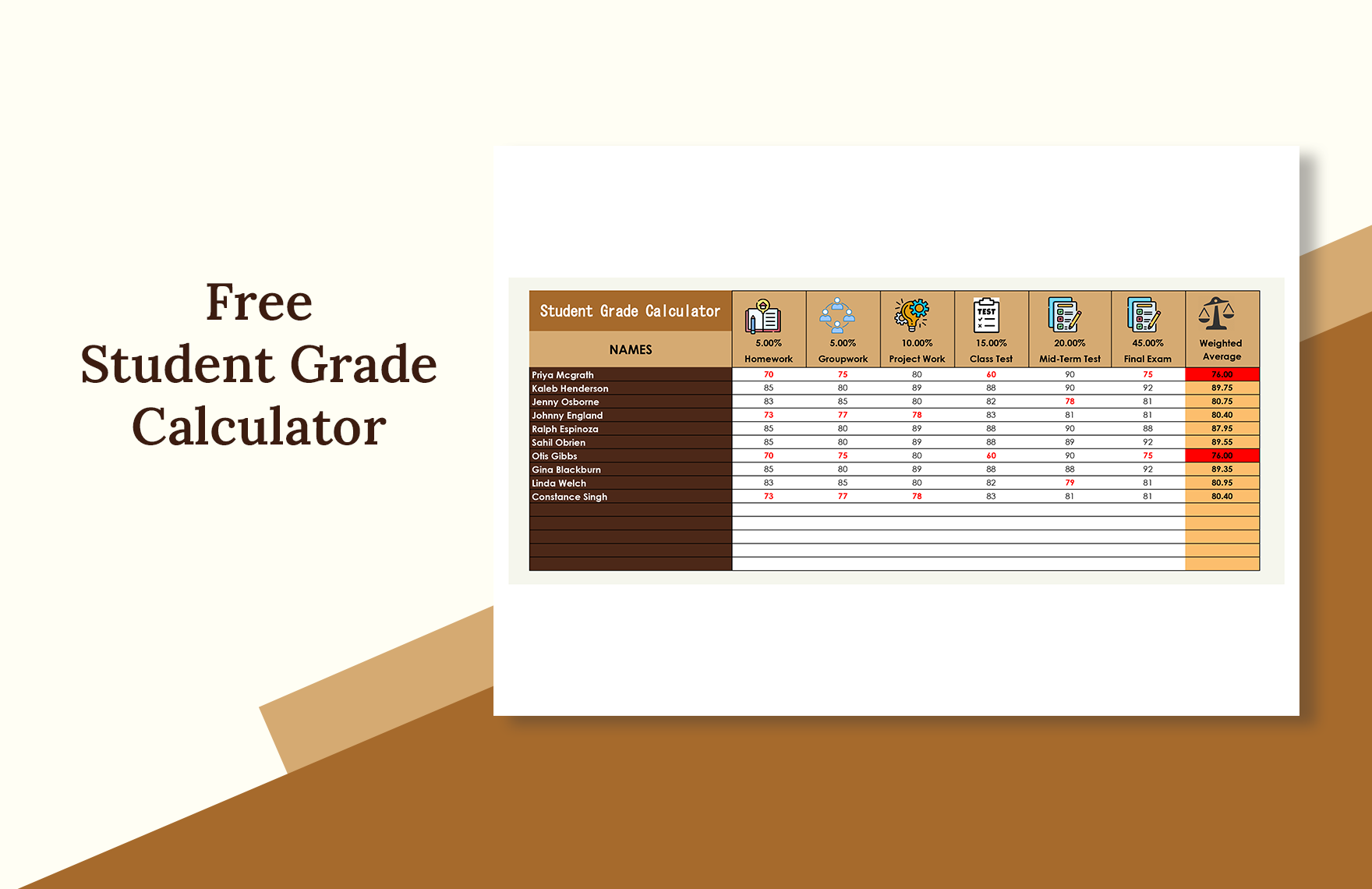
However, real courses often involve multiple grading components. Homework might account for 20% of the course, tests for 30%, projects for 20%, and the final examination for 30%. In that situation, simply averaging every score may produce an incorrect result. A weighted calculation is needed.
How Does Grade Calculation Work?
The basic process depends on the grading system used by a school, college, or university. The first step is to identify the marks received and the maximum marks available for each assessment.
For an unweighted course, students can add all earned marks and divide them by the total possible marks. For example, if a student earns 420 marks out of 500, the overall percentage is 84%.
Weighted grading works differently. Each category has a specific contribution to the final result. The student’s score in each category is converted into a percentage and then multiplied by its assigned weight.
Consider this example:
- Assignments: 90% with a 20% course weight
- Tests: 80% with a 30% course weight
- Project: 85% with a 20% course weight
- Final exam: 75% with a 30% course weight
The weighted result is calculated as:
90 × 0.20 + 80 × 0.30 + 85 × 0.20 + 75 × 0.30
This produces an overall course grade of 81%.
The example shows why understanding weighting matters. A lower score in a heavily weighted category can affect the final result more than a similar score in a small assignment.
Why Students Use Grade Calculators
Students often need to know more than their current percentage. They may want to determine what score they need on an upcoming examination to reach a particular final grade.
For instance, imagine a student currently has an 82% average, and the final exam represents 25% of the course. If the student wants to finish with at least 85%, the required exam score can be calculated using the current weighted contribution and the remaining assessment weight.
This type of calculation can turn a vague academic goal into a specific target. Rather than simply thinking, “I need to do better,” a student can determine the approximate score needed and plan accordingly.
A grade calculator can also help students:
- Track academic progress during a semester.
- Identify subjects that need additional attention.
- Estimate possible final results.
- Compare current performance with a target grade.
- Understand the effect of a major examination or project.
Understanding Letter Grades and Percentages
Different educational institutions use different grading scales. One school might consider 90% an A, while another may use a different threshold. Some institutions also use plus and minus grades, while others rely entirely on percentages or grade points.
A general example of a percentage-to-letter system is shown below:
| Percentage Range | Example Letter Grade | General Interpretation |
|---|---|---|
| 90–100% | A | Excellent |
| 80–89% | B | Very Good |
| 70–79% | C | Satisfactory |
| 60–69% | D | Passing in many systems |
| Below 60% | F | Below passing level |
These ranges are only an example and should not be treated as a universal academic standard. Students should always check their institution’s official grading policy before interpreting a result.
Weighted Grades Versus Simple Averages
One of the most common sources of confusion is the difference between a simple average and a weighted average.
A simple average gives every score equal importance. If a student earns 70%, 80%, and 90%, the average is 80%.
A weighted average assigns different importance to each score. If the 70% score represents 10% of the course, the 80% score represents 30%, and the 90% score represents 60%, the final result will be much closer to 90% than 70%.
This distinction becomes especially important in college courses. A final examination may account for a large portion of the total grade, while several smaller assignments may contribute only modestly. Using the wrong method can therefore lead students to believe their academic standing is better or worse than it actually is.
How to Calculate Your Required Final Exam Score
One of the most useful applications of a grade calculator is estimating the score required on a final assessment.
Suppose a student has completed 75% of a course and currently has an average of 84%. The final examination is worth the remaining 25%. If the student wants an overall course grade of 85%, the calculation can be represented as:
(84 × 0.75) + (Required Exam Score × 0.25) = 85
The completed work contributes 63 percentage points. The student therefore needs the final exam to provide the remaining 22 points.
Required Exam Score = 22 ÷ 0.25 = 88%
So, the student would need approximately 88% on the final exam to finish the course with an 85% overall grade.
This approach is helpful because it connects a desired final result with a measurable academic target.
Grade Calculations and GPA
A percentage grade and a grade point average are related, but they are not identical. GPA generally converts letter grades or course results into numerical grade points according to a specific institutional scale.
For example, on a hypothetical four-point scale, an A might correspond to 4.0, a B to 3.0, and a C to 2.0. However, institutions can use different scales and may assign different points to plus and minus grades.
GPA calculations may also consider course credit hours. A four-credit course can have a larger effect on GPA than a one-credit course because its grade contributes more heavily to the overall calculation.
Therefore, students should use the grading and GPA rules provided by their institution rather than assuming that every school follows the same conversion.
Common Mistakes to Avoid
Even a straightforward calculation can produce an inaccurate result when incorrect information is entered. One common mistake is confusing points with percentages. A score of 45 out of 50 is 90%, not 45%.
Another mistake is ignoring missing or ungraded work. If an upcoming assignment has not yet been completed, it may not be included in the current average but could significantly affect the final grade.
Students should also verify whether dropped assignments, extra credit, participation marks, bonus points, or replacement examinations are included in the course policy. Some grading systems use special rules that a basic calculation cannot automatically recognize.
Finally, always check whether the teacher calculates grades by total points, weighted categories, or another method. The syllabus is often the best source for this information.
Tips for Using a Grade Calculator Effectively
The best results come from using accurate and up-to-date information. Enter each assessment according to the actual grading structure instead of treating every assignment as equally important.
It is also useful to calculate several scenarios. A student might check what happens if the next exam score is 70%, 80%, or 90%. Comparing these possibilities can make academic planning more realistic.
Keep a record of assessment weights throughout the semester. When a major exam approaches, knowing exactly how much it contributes to the final result can help prioritize revision.
Most importantly, use calculated results as planning information rather than as a replacement for official grades. The final grade issued by the instructor or institution remains authoritative.
How Teachers and Parents Can Use Grade Calculations
Grade calculations are not limited to students. Teachers can use them to explain assessment structures and show how individual assignments contribute to course outcomes. Clear calculations can also help students understand why one examination may have a greater effect on their final result than several smaller tasks.
Parents and academic advisers can use calculated results when discussing study habits and educational goals. Instead of focusing only on whether a student passed or failed, they can examine patterns across assignments and identify areas where additional support may be useful.
This makes academic performance easier to understand and encourages more informed conversations about progress.
Conclusion
A grade calculator provides a simple way to understand academic performance, whether the goal is finding a percentage, estimating a final course result, or determining a target score for an upcoming examination. The key is understanding whether the course uses total points, simple averages, or weighted categories.
Accurate calculations can help students set realistic targets, organize their study schedules, and recognize which assessments have the greatest impact on their final results. However, grading policies vary between schools and institutions, so calculated estimates should always be compared with the official course rules.
When used correctly, a grade calculator is more than a way to check marks. It can become a useful planning tool that gives students a clearer picture of their academic progress and helps them make smarter decisions throughout the school or college year.