
Introduction
A grade calculator is a useful tool for students who want to understand their academic performance without spending time working through complicated calculations. Grades can be based on assignments, quizzes, projects, tests, exams, attendance, and other activities, each carrying a different weight. Because of this, calculating an overall score manually can sometimes become confusing. A reliable grade calculator makes the process easier by helping students estimate their current percentage, weighted score, or expected final grade. It can also help learners set realistic academic goals before an upcoming examination. Whether you are in school, college, university, or taking an online course, understanding how grades are calculated can help you make better study decisions. Instead of simply waiting for a final report, you can use your available scores to understand where you currently stand and what you may need to improve.
What Is a Grade Calculator?
A grade calculator is a calculation tool designed to determine a student’s overall academic score from individual grades. It can be used with simple points-based grading systems or weighted categories where different assignments contribute different percentages to the final result. For example, an instructor may assign 20% of the final grade to homework, 30% to quizzes, and 50% to examinations. Entering the relevant scores and weights allows the calculator to estimate the student’s overall result. Depending on the grading system, the final percentage may then be converted into a letter grade such as A, B, C, or D. This makes it easier for students to understand their performance. A grade calculator is particularly helpful when several assessments have already been completed and a student wants to know the approximate score needed on a remaining exam to achieve a particular final grade.
How Does a Grade Calculator Work?
The basic operation of a grade calculator is straightforward. First, you enter the scores you have received and the maximum possible scores or percentage weights associated with them. The tool then applies the appropriate mathematical formula to produce a combined result. In a points-based system, the calculation can be made by dividing total points earned by total points possible and multiplying the result by 100. For weighted grades, each individual score is multiplied by its assigned weight, and the resulting values are added together. This approach ensures that an assessment worth 40% of a course contributes more to the final grade than an assignment worth 5%. Understanding this process is useful because it allows students to check whether a calculated result makes sense and identify mistakes in their entries.
Basic Grade Calculation Formula
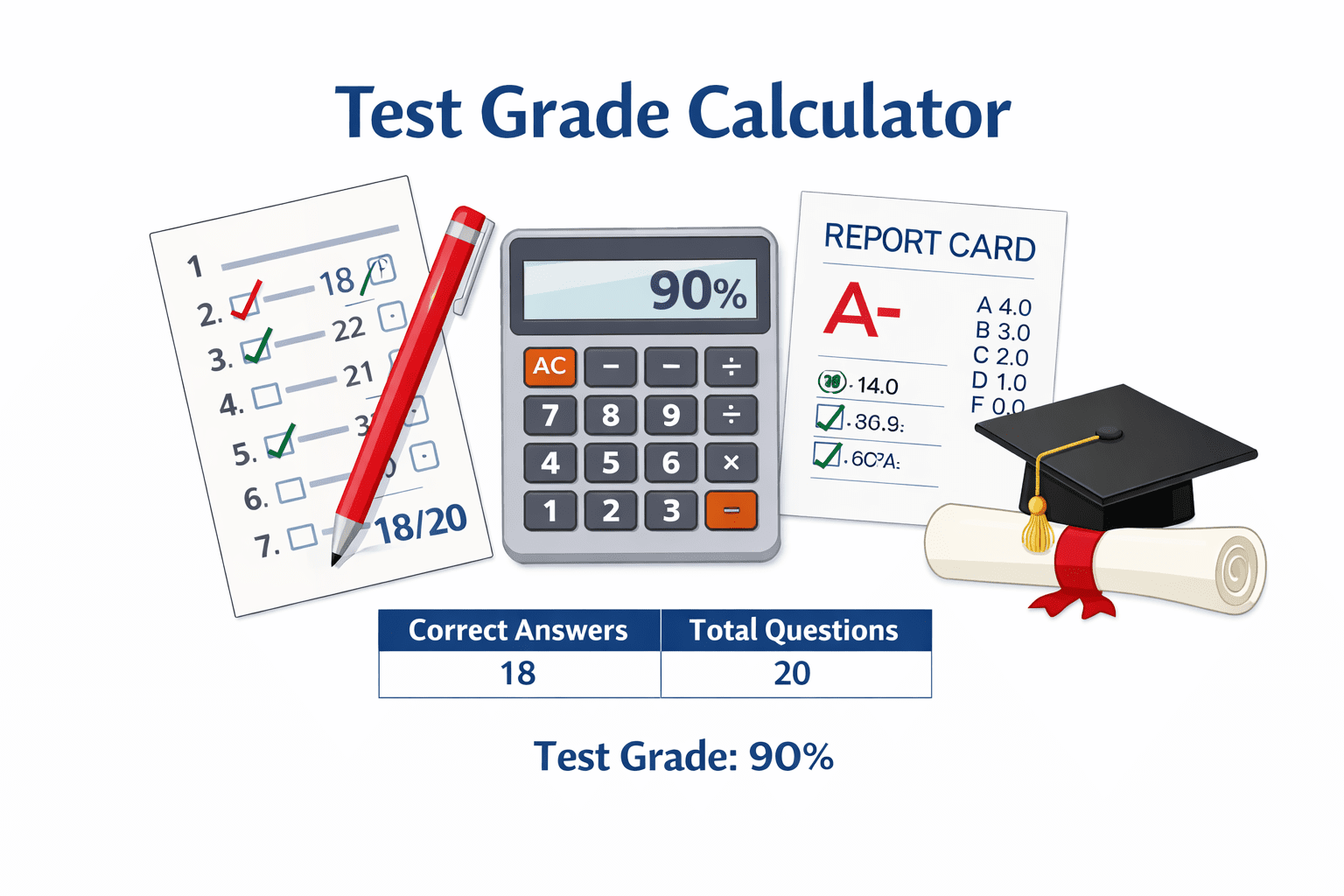
Although online tools can perform calculations automatically, knowing the basic formula is valuable. For a simple percentage calculation, divide the points earned by the total points possible and multiply by 100.
Percentage = (Points Earned ÷ Total Points Possible) × 100
For example, if a student earns 420 points out of 500, the percentage is:
(420 ÷ 500) × 100 = 84%
In a weighted grading system, the calculation is slightly different. Suppose homework contributes 20%, quizzes contribute 30%, and the final examination contributes 50%. If the student scores 90%, 80%, and 85% respectively, the weighted result is calculated by multiplying each score by its weight and adding the results. This gives a clearer picture of overall performance because every assessment contributes according to its importance.
Why Students Use a Grade Calculator
Students use grade calculators for several practical reasons. One major advantage is that they can quickly monitor academic progress during a semester instead of waiting until the course ends. Knowing a current grade can encourage students to focus on subjects or assessment categories where improvement is most needed. The tool can also help students create realistic targets for upcoming tests. For instance, if a student wants to finish a course with a specific percentage, they can estimate what score they need on the remaining examination.
Other benefits include:
- Checking current academic performance.
- Estimating a final course grade.
- Understanding weighted assignments.
- Planning study priorities.
- Comparing current scores with academic targets.
Grade Calculation Example
Consider a course with four assessment categories. Homework is worth 20%, quizzes are worth 20%, a midterm is worth 25%, and the final examination is worth 35%. Suppose a student receives 88% in homework, 82% in quizzes, 79% in the midterm, and 90% in the final examination.
| Assessment | Score | Weight |
|---|---|---|
| Homework | 88% | 20% |
| Quizzes | 82% | 20% |
| Midterm | 79% | 25% |
| Final Exam | 90% | 35% |
To find the weighted result, each score is multiplied by its weight. The individual contributions are then added together. The final weighted percentage provides a better representation of the student’s performance than simply averaging all four percentages, because the final examination carries greater importance in the course grading structure.
Weighted Grades vs. Simple Grades
One of the most important things students should understand is the difference between simple and weighted grading. In a simple grading system, every assessment may have the same importance, so the scores can be averaged directly. In a weighted system, each category contributes a predetermined percentage to the final result. A student who earns 90% on a small assignment and 70% on a major examination cannot necessarily assume that the final average is 80%. The examination may have a much larger impact.
A grade calculator can make this distinction easier to understand. Before calculating a final score, students should check their syllabus or course instructions to determine whether assignments are equally weighted or divided into categories. Using the wrong grading method can produce an inaccurate result, even when the individual scores have been entered correctly.
How to Calculate the Grade You Need
Another useful function of a grade calculator is estimating the score required on a future assessment. Suppose you know your current weighted grade and want to achieve a particular final percentage. You can use the remaining assessment weight to determine the score required. For example, if completed coursework accounts for 70% of the course and the final exam accounts for 30%, your current performance determines part of the final result while the examination determines the remaining portion.
 This calculation can help students set achievable goals. If the required examination score is unusually high, the student may need to review earlier opportunities for extra credit or speak with the instructor about course policies. If the required score is comfortably within reach, the student can focus on preparing effectively rather than worrying about an unknown outcome.
Common Mistakes When Calculating Grades
Manual grade calculations can lead to errors, especially when a course includes many assignments or different weighting systems. One common mistake is adding percentages without considering their weights. Another is entering points earned without checking the maximum possible points. Students may also forget to include a recently completed assessment or accidentally count an assignment twice.
To avoid these problems, check the following before calculating:
- Confirm every assessment score.
- Verify the weight of each category.
- Check whether extra credit is included.
- Make sure missing assignments are treated correctly.
- Review the final calculation before using it for academic decisions.
Tips for Using Grade Calculations Effectively
A grade calculator becomes more useful when students treat it as part of regular academic planning. Instead of checking grades only before examinations, students can update their calculations after major assessments. This creates a clearer picture of progress throughout the semester. Keeping a simple record of scores, weights, and completed assignments can also make future calculations faster.
Students should remember that calculated grades are sometimes estimates. Schools and universities may use different grading scales, rounding rules, dropped assignments, extra credit policies, or special weighting methods. Therefore, the official grade recorded by the institution remains the final authority. A calculator should be used as a planning and understanding tool rather than as a replacement for official academic records.
Understanding Letter Grades
Many educational systems convert percentages into letter grades. However, grading scales can differ between institutions. One school may consider 90% an A, while another may use a different threshold. Some courses may also use plus and minus grades, such as B+ or A-. Students should therefore check the grading policy for their specific course before interpreting a calculated percentage.
| Percentage Range | Example Letter Grade |
| 90–100% | A |
| 80–89% | B |
| 70–79% | C |
| 60–69% | D |
| Below 60% | F |
The table above is only an example because grading standards vary. A grade calculator can provide the percentage, but the applicable grading scale determines the corresponding letter.
Benefits for Students and Teachers
The usefulness of a grade calculator is not limited to students. Teachers can also use calculation methods to verify weighted assessment structures and explain grading systems to learners. Students benefit from greater transparency because they can see how individual assessments affect their overall results. Parents and academic advisers may also use estimated grades when discussing study progress and educational goals.
When students understand how their scores contribute to a final result, they are more likely to make informed decisions about where to spend their study time. A low score on a heavily weighted assessment may deserve more attention than a similar score on a minor assignment. This understanding turns grades into useful information rather than simply numbers on a report.
Conclusion
A grade calculator provides a convenient way to understand academic performance, estimate weighted scores, and plan for future assessments. By entering accurate scores and using the correct grading weights, students can quickly determine their current percentage and estimate possible final results. The tool is especially helpful for courses that combine homework, quizzes, projects, midterms, and final examinations. However, students should always confirm the grading policy used by their school or instructor because grading scales and calculation rules can vary. Used correctly, a grade calculator can support better academic planning, highlight areas that need improvement, and reduce confusion around complicated grading systems. Most importantly, it encourages students to take an active role in understanding their progress and setting practical academic goals.