
A scientific calculator is a powerful tool designed to handle mathematical operations that go beyond basic addition, subtraction, multiplication, and division. It is commonly used by students, teachers, engineers, scientists, technicians, and anyone who needs to solve more advanced calculations accurately. Unlike a standard calculator, it can work with trigonometric functions, logarithms, powers, roots, fractions, scientific notation, and other mathematical expressions.
Modern calculators are available as handheld devices as well as digital tools on computers, smartphones, and websites. Understanding how these functions work can make complicated calculations faster and reduce mistakes. Whether you are studying algebra, geometry, physics, chemistry, statistics, or higher mathematics, learning to use the right functions can save considerable time.
What Is a Scientific Calculator?
A scientific calculator is an electronic or digital calculating device built to perform advanced mathematical operations. It extends the capabilities of an ordinary calculator by providing functions commonly required in school, college, technical education, and professional fields.
Basic calculators are suitable for straightforward arithmetic, but advanced mathematical problems often involve several steps and specialized formulas. A scientific calculator can evaluate expressions containing exponents, square roots, trigonometric ratios, logarithms, percentages, and parentheses.
For example, calculating the square root of 144 is simple, but evaluating expressions such as sin(45°), log(100), or 3⁵ requires dedicated mathematical functions. More advanced models can also work with fractions, permutations, combinations, statistics, complex numbers, matrices, and equation-solving features.
The exact capabilities vary by model, so users should understand which functions their particular device supports before relying on it for advanced work.
Why Is a Scientific Calculator Useful?
The main advantage is that it handles complicated mathematical operations more efficiently than manual calculation. Instead of performing several intermediate calculations separately, users can often enter an entire expression and obtain the result in one operation.
It is especially useful when accuracy matters. Manual calculations involving decimals, square roots, logarithms, or trigonometric values can easily produce errors. A calculator reduces repetitive arithmetic and allows students and professionals to concentrate on the method behind the problem.
Common benefits include:
- Faster calculation of complex expressions
- Support for trigonometric and logarithmic functions
- Easier handling of fractions, powers, and roots
- Reduced arithmetic errors
- Convenient scientific notation for very large or small numbers
- Assistance with statistics and probability on supported models
However, the calculator should support understanding rather than replace it. Knowing the formula and why it is being used remains essential.
Key Functions You Should Understand
Different models offer different features, but several functions appear frequently across scientific calculators.
Trigonometric functions: Sine, cosine, and tangent are widely used in geometry, physics, engineering, and navigation. Their inverse functions can help determine angles when a ratio is known.
Logarithmic functions: Common logarithms and natural logarithms are important in mathematics, chemistry, physics, finance, and other technical subjects.
Powers and roots: Functions such as x², xʸ, square root, and cube root make it easier to work with exponential expressions.
Fractions: Many models allow users to enter fractions directly and convert between fractional and decimal forms.
Parentheses: Parentheses control the order in which operations are performed. They are particularly important when entering multi-step expressions.
Scientific notation: This feature is useful for representing extremely large or tiny values, such as measurements in physics or chemistry.
Memory functions: Memory keys can temporarily store values, which is helpful when a calculation contains repeated numbers.
Common Functions and Their Uses
| Function | Typical Purpose | Example |
|---|---|---|
| √ | Finding square roots | √81 = 9 |
| x² | Squaring a number | 7² = 49 |
| xʸ | Raising a number to a power | 2⁵ = 32 |
| sin, cos, tan | Trigonometry | sin(30°) = 0.5 |
| log | Common logarithm | log(100) = 2 |
| ln | Natural logarithm | ln(e) = 1 |
| π | Circle-related calculations | 2πr |
| ! | Factorials | 5! = 120 |
| EXP/×10ˣ | Scientific notation | 3 × 10⁶ |
The displayed results can depend on settings such as angle mode, number format, and rounding. Checking these settings before beginning a calculation is therefore important.
How to Use a Scientific Calculator Correctly
Using an advanced calculator effectively involves more than pressing buttons. Start by identifying the type of problem and the formula required. Then check whether the calculator is set to the correct mode.
For trigonometry, one of the most important settings is the angle unit. Degrees, radians, and sometimes gradians produce different results. For example, sin(90°) equals 1, while sin(90 radians) produces a completely different value. A correct formula can therefore give an unexpected answer if the mode is wrong.
Next, enter expressions carefully. Parentheses should be used when necessary to preserve the intended order of operations. After receiving an answer, consider whether it is reasonable. Estimating the expected size of a result is a useful way to identify input errors.
For important assignments or professional calculations, keeping intermediate steps written down is also beneficial. The calculator provides the numerical result, but the written process explains how that result was obtained.
Scientific Calculator Examples in Everyday Study
Consider a simple geometry problem involving a circle with a radius of 5 units. The area is calculated using the formula:
Area = πr²
Substituting the radius gives:
Area = π × 5²
The calculator can evaluate the expression quickly and provide a decimal approximation. The important part, however, is recognizing that the radius must be squared before multiplying by π.
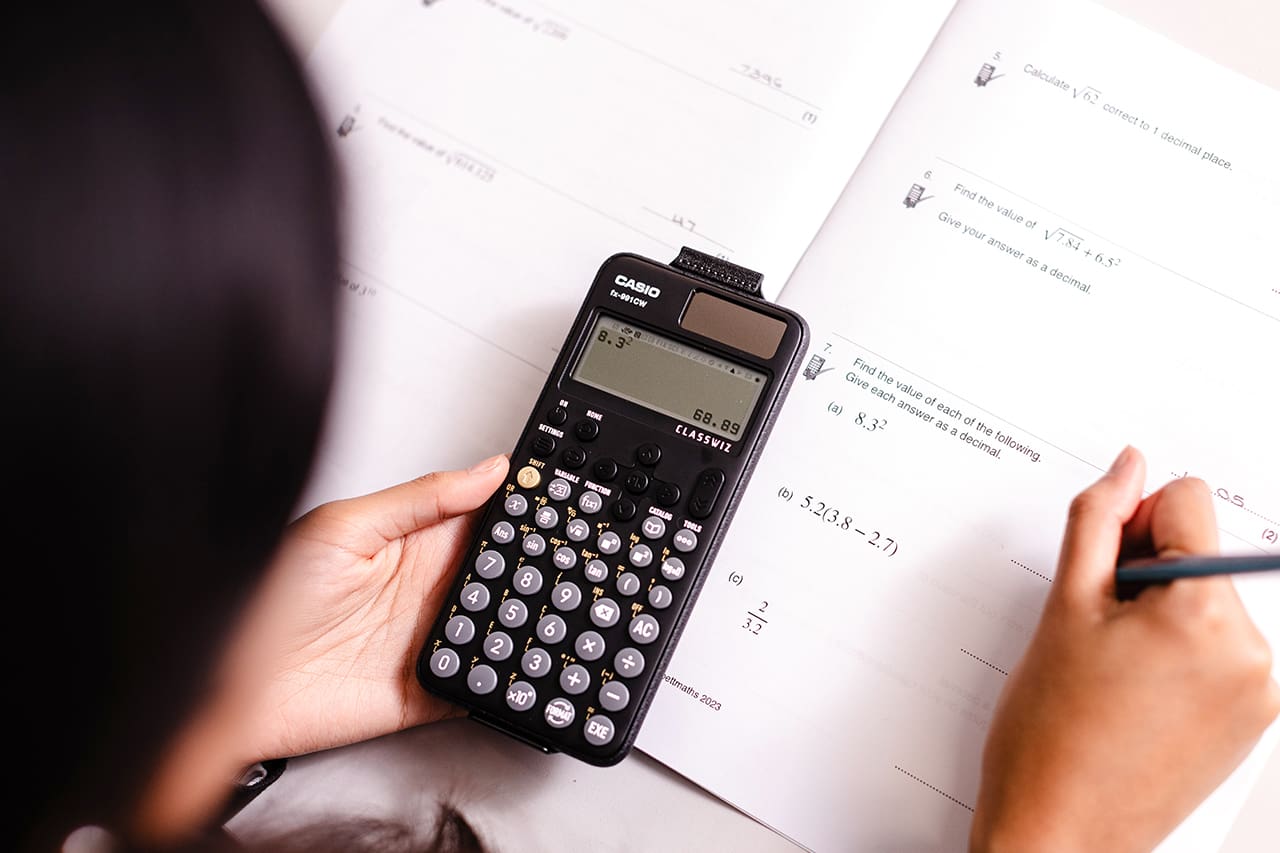 A trigonometry problem provides another example. Suppose a right triangle has an angle of 30 degrees and you need its sine value. Entering the appropriate function while the calculator is in degree mode produces the expected result.
In science subjects, scientific notation is particularly valuable. A measurement such as 0.00000045 can be represented more conveniently as 4.5 × 10⁻⁷. This makes calculations involving very large or very small quantities easier to read and manage.
Who Can Benefit From One?
Students are among the most common users because advanced mathematics frequently requires more than basic arithmetic. Algebra, trigonometry, statistics, physics, and chemistry all involve calculations that can become time-consuming when performed manually.
Teachers can also use these tools to demonstrate mathematical concepts and verify worked examples. Engineering and technical students may need functions for formulas involving angles, powers, logarithms, and scientific notation.
Professionals working with measurements and numerical formulas can benefit as well. Depending on the field, specialized calculators may include additional capabilities for statistics, equations, matrices, or complex numbers.
Before purchasing a device for academic use, users should check whether their school, university, examination board, or workplace permits the model. Some examinations restrict programmable or graphing calculators even though simpler scientific models may be allowed.
Common Mistakes to Avoid
Many calculation errors come from incorrect input rather than from the calculator itself. One common mistake is forgetting to check the angle mode before using trigonometric functions. Another is entering a formula without the necessary parentheses.
Users can also accidentally round values too early. Keeping additional decimal places during intermediate calculations and rounding only the final answer generally provides better precision.
Other mistakes include:
- Confusing the negative sign with subtraction
- Using the wrong logarithm function
- Forgetting to close parentheses
- Misreading scientific notation
- Entering degrees when radians are required
- Assuming every calculator uses identical button layouts
Reading the user manual can be surprisingly helpful, especially when a model has secondary functions accessed through SHIFT, 2nd, or similar keys.
Choosing the Right Calculator
The best calculator depends on what you need it to do. A secondary-school student may only require trigonometry, logarithms, fractions, powers, and basic statistics. A university student in engineering or mathematics may need more advanced equation, matrix, or complex-number functions.
Consider these factors before choosing a model:
Function range: Make sure it includes the operations required for your subjects.
Display: A natural textbook-style display can make fractions and expressions easier to read.
Ease of use: A large number of functions is useful only if you can access them confidently.
Power source: Battery-powered and solar-assisted options are common, with each offering practical advantages.
Exam compatibility: Always verify whether the calculator meets the rules for your intended examination.
A more expensive model is not automatically better. The ideal choice is one that provides the necessary functions without adding unnecessary complexity.
Tips for Better and Faster Calculations
Developing good habits can make calculator use more reliable. First, learn the functions that you use most often rather than trying to memorize every button. Practice entering complete expressions so that you become comfortable with parentheses and operation order.
Keep an eye on the display before pressing equals. A quick check can catch missing decimal points, incorrect signs, or misplaced parentheses. When solving several related problems, use memory functions when appropriate instead of repeatedly re-entering the same value.
It is also useful to estimate an answer before calculating it. If your mental estimate is around 50 but the calculator displays 5,000, stop and investigate before continuing.
Most importantly, understand the mathematics behind each calculation. A calculator can verify arithmetic, but it cannot determine whether you selected the correct formula or interpreted a question correctly.
Digital Options and Modern Calculator Tools
Today, users are not limited to handheld devices. Online calculators and calculator applications can provide many of the same mathematical functions through a computer or smartphone.
Digital tools can be convenient because they may offer larger displays, equation history, copy-and-paste features, and additional mathematical capabilities. Some advanced platforms can also display graphs or provide step-by-step solutions.
However, convenience should not come at the expense of accuracy or privacy. When using an online tool for important work, verify the result with another method when possible and avoid entering sensitive information into an unfamiliar service.
For examinations and classroom work, a physical calculator may still be preferable because internet access and mobile devices can be restricted.
Conclusion
A scientific calculator makes advanced mathematical work faster, more manageable, and less prone to routine arithmetic errors. From trigonometry and logarithms to powers, roots, fractions, and scientific notation, its functions cover many calculations encountered in education and technical fields.
The most effective users do not simply depend on the displayed answer. They understand the formula, select the correct mode, enter expressions carefully, and check whether the result makes sense. With regular practice, even a feature-rich calculator becomes straightforward to operate.
Whether you are preparing for an examination, studying mathematics, completing a science assignment, or working with technical formulas, choosing an appropriate calculator and learning its essential functions can make numerical problem-solving considerably more efficient.