Introduction
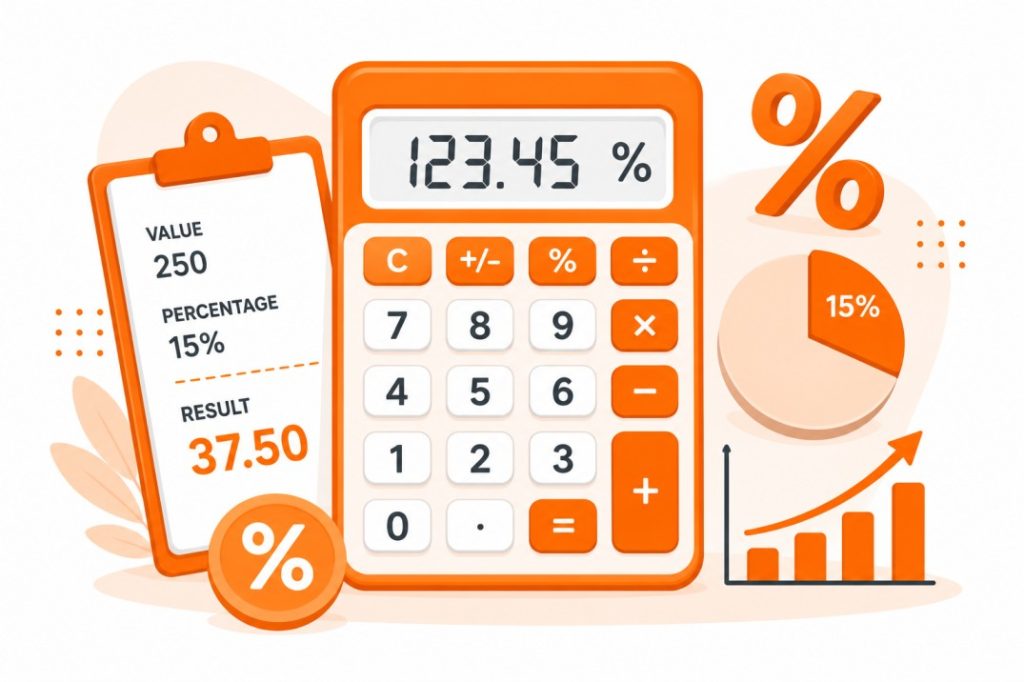
A percentage calculator is one of the most useful mathematical tools for students, teachers, business owners, shoppers, and professionals. Whether you need to calculate discounts while shopping, determine exam scores, analyze business profits, or compute taxes, percentages play an important role in everyday life. Although percentages can be calculated manually using formulas, a percentage calculator makes the process much faster and eliminates the chances of calculation errors.
Understanding percentages is an essential mathematical skill because they are used in almost every field. Banks use percentages to calculate interest rates, schools use them for grading systems, businesses rely on them to measure growth, and online stores display discounts in percentage form. Learning how a percentage calculator works helps users save time while improving accuracy.
In this comprehensive guide, you’ll learn what a percentage calculator is, how it works, different percentage formulas, practical applications, advantages, common mistakes, and tips for accurate calculations.
What Is a Percentage Calculator?
A percentage calculator is a tool designed to solve percentage-related problems instantly. Instead of performing lengthy manual calculations, users simply enter the required values, and the calculator automatically provides the result.
The calculator can solve many common percentage questions, including:
- What is 25% of 500?
- What percentage is 45 out of 60?
- A product increased from 200 to 260. What is the percentage increase?
- A product decreased from 900 to 750. What is the percentage decrease?
Because percentage calculations are required in academics, finance, sales, statistics, and business reporting, this calculator has become one of the most widely used mathematical tools available today.
Why Percentage Calculations Matter
Percentages help people compare values easily. Instead of comparing raw numbers, percentages provide a standardized measurement that everyone can understand.
For example, if one student scores 90 out of 100 while another scores 45 out of 50, percentages reveal that both students achieved 90%, making comparison much easier.
Businesses also depend on percentages to evaluate yearly sales growth, customer satisfaction, profit margins, and employee performance. Investors use percentages to measure returns, while healthcare professionals use them in medical reports and statistical analysis.
Without percentage calculations, interpreting numerical data would become much more complicated.
Common Percentage Formulas
Understanding the basic formulas helps users verify the results generated by a percentage calculator.
| Calculation | Formula |
|---|---|
| Percentage | (Value ÷ Total) × 100 |
| Percentage of a Number | (Percentage ÷ 100) × Number |
| Percentage Increase | ((New − Old) ÷ Old) × 100 |
| Percentage Decrease | ((Old − New) ÷ Old) × 100 |
These formulas form the foundation of nearly every percentage calculation used in education, finance, and business.
How a Percentage Calculator Works
Although the calculation process appears simple, the calculator follows mathematical formulas behind the scenes. Users only need to enter the available values, and the calculator performs all computations automatically.
For example:
Suppose you want to know 35% of 800.
The calculation is:
35 ÷ 100 × 800
= 280
Instead of solving this manually, the percentage calculator provides the answer instantly.
Similarly, if you need to determine what percentage 72 is out of 90, the calculator performs the calculation:
72 ÷ 90 × 100
= 80%
This saves time while ensuring accurate results.
Everyday Uses of a Percentage Calculator
Most people use percentages without even realizing it. Shopping is one of the most common examples. During seasonal sales, stores advertise discounts such as 20%, 40%, or even 70%. A percentage calculator quickly determines how much money customers will actually save.
Students also use percentages to calculate examination results, semester grades, assignment scores, and attendance percentages. Teachers rely on percentages when preparing report cards and evaluating academic performance.
In finance, percentages are used to calculate interest rates, investment returns, tax deductions, profit margins, and loan repayments. Businesses analyze percentage growth to understand market performance and customer trends.
Sports statistics also depend heavily on percentages. Winning percentages, batting averages, shooting accuracy, and success rates all use percentage calculations to compare performances fairly.
Because percentages simplify numerical comparisons, they remain valuable across countless industries and everyday situations.