
Percentage Calculator: Complete Guide for Accurate Percentage Calculations

Date:

Share post:

Introduction

A percentage calculator is one of the most useful mathematical tools for students, teachers, business owners, shoppers, and professionals. Whether you need to calculate discounts while shopping, determine exam scores, analyze business profits, or compute taxes, percentages play an important role in everyday life. Although percentages can be calculated manually using formulas, a percentage calculator makes the process much faster and eliminates the chances of calculation errors.

Understanding percentages is an essential mathematical skill because they are used in almost every field. Banks use percentages to calculate interest rates, schools use them for grading systems, businesses rely on them to measure growth, and online stores display discounts in percentage form. Learning how a percentage calculator works helps users save time while improving accuracy.

In this comprehensive guide, you’ll learn what a percentage calculator is, how it works, different percentage formulas, practical applications, advantages, common mistakes, and tips for accurate calculations.

What Is a Percentage Calculator?

A percentage calculator is a tool designed to solve percentage-related problems instantly. Instead of performing lengthy manual calculations, users simply enter the required values, and the calculator automatically provides the result.

The calculator can solve many common percentage questions, including:

  • What is 25% of 500?
  • What percentage is 45 out of 60?
  • A product increased from 200 to 260. What is the percentage increase?
  • A product decreased from 900 to 750. What is the percentage decrease?

Because percentage calculations are required in academics, finance, sales, statistics, and business reporting, this calculator has become one of the most widely used mathematical tools available today.

Why Percentage Calculations Matter

Percentages help people compare values easily. Instead of comparing raw numbers, percentages provide a standardized measurement that everyone can understand.

For example, if one student scores 90 out of 100 while another scores 45 out of 50, percentages reveal that both students achieved 90%, making comparison much easier.

Businesses also depend on percentages to evaluate yearly sales growth, customer satisfaction, profit margins, and employee performance. Investors use percentages to measure returns, while healthcare professionals use them in medical reports and statistical analysis.

Without percentage calculations, interpreting numerical data would become much more complicated.

Common Percentage Formulas

Understanding the basic formulas helps users verify the results generated by a percentage calculator.

Calculation Formula
Percentage (Value ÷ Total) × 100
Percentage of a Number (Percentage ÷ 100) × Number
Percentage Increase ((New − Old) ÷ Old) × 100
Percentage Decrease ((Old − New) ÷ Old) × 100

These formulas form the foundation of nearly every percentage calculation used in education, finance, and business.

How a Percentage Calculator Works

Although the calculation process appears simple, the calculator follows mathematical formulas behind the scenes. Users only need to enter the available values, and the calculator performs all computations automatically.

For example:

Suppose you want to know 35% of 800.

The calculation is:

35 ÷ 100 × 800

= 280

Instead of solving this manually, the percentage calculator provides the answer instantly.

Similarly, if you need to determine what percentage 72 is out of 90, the calculator performs the calculation:

72 ÷ 90 × 100

= 80%

This saves time while ensuring accurate results.

Everyday Uses of a Percentage Calculator

Most people use percentages without even realizing it. Shopping is one of the most common examples. During seasonal sales, stores advertise discounts such as 20%, 40%, or even 70%. A percentage calculator quickly determines how much money customers will actually save.

Students also use percentages to calculate examination results, semester grades, assignment scores, and attendance percentages. Teachers rely on percentages when preparing report cards and evaluating academic performance.

In finance, percentages are used to calculate interest rates, investment returns, tax deductions, profit margins, and loan repayments. Businesses analyze percentage growth to understand market performance and customer trends.

Sports statistics also depend heavily on percentages. Winning percentages, batting averages, shooting accuracy, and success rates all use percentage calculations to compare performances fairly.

Because percentages simplify numerical comparisons, they remain valuable across countless industries and everyday situations.
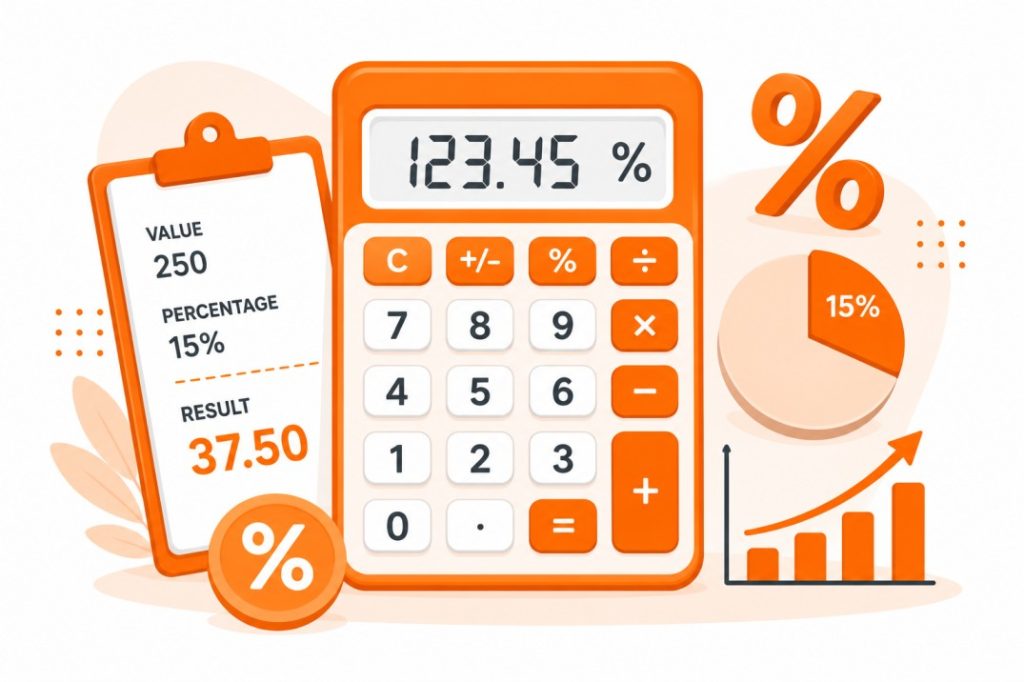

Percentage Increase and Percentage Decrease

One of the most practical uses of a percentage calculator is measuring how much a value has increased or decreased over time. Businesses, investors, students, and even households rely on these calculations to compare changes accurately. percentage calculator

For example, if a company’s monthly sales rise from $10,000 to $12,500, the percentage increase formula shows a 25% growth. Likewise, if the price of a product drops from $800 to $600, the percentage decrease is 25%. These calculations provide a clearer understanding of changes than simply comparing numbers.

Using a calculator saves time and minimizes the risk of manual errors, especially when dealing with large figures or frequent calculations. Financial reports, market analyses, and academic projects often require these calculations, making them an essential skill. Whether tracking business performance, comparing yearly expenses, or analyzing investments, percentage increases and decreases help present information in a meaningful and standardized way.

Benefits of Using a Percentage Calculator

A percentage calculator offers several advantages over manual calculations. It provides quick and accurate results, reducing the possibility of arithmetic mistakes. This is especially helpful when calculations involve decimal values or large numbers.

Another major benefit is convenience. Instead of remembering multiple formulas, users simply enter the required values and receive instant results. This saves valuable time during exams, office work, budgeting, or shopping.

The calculator is also highly versatile. It can calculate percentages, determine percentage increases and decreases, compare values, and solve everyday mathematical problems. Because it works for students, professionals, entrepreneurs, and individuals alike, it has become an indispensable digital tool.

In addition, many online percentage calculators are mobile-friendly, allowing users to perform calculations from smartphones, tablets, or computers without installing specialized software.

Common Mistakes When Calculating Percentages

Despite their simplicity, percentage calculations can sometimes lead to errors if formulas are applied incorrectly. One of the most common mistakes is confusing the numerator and denominator when calculating a percentage.

Another frequent error is forgetting to multiply the result by 100 after dividing two values. This often produces a decimal instead of the required percentage.

Users also occasionally misunderstand percentage increases and decreases by subtracting percentages directly instead of calculating the actual change based on the original value. This can lead to inaccurate conclusions, particularly in financial analysis.

Rounding numbers too early is another issue. While rounding makes numbers easier to read, it may reduce accuracy in calculations involving taxes, interest rates, or scientific data. Performing calculations with full precision and rounding only the final answer generally produces the most reliable results.

Practical Examples

Practical examples make percentage concepts easier to understand and apply.

Scenario Calculation Result
20% of 250 (20 ÷ 100) × 250 50
45 out of 60 (45 ÷ 60) × 100 75%
Increase from 500 to 650 ((650 − 500) ÷ 500) × 100 30%
Decrease from 900 to 720 ((900 − 720) ÷ 900) × 100 20%
15% Discount on $400 (15 ÷ 100) × 400 $60 Discount

These examples demonstrate how percentage calculations appear in everyday situations such as shopping, education, business, and personal finance.

Tips for Accurate Percentage Calculations

While a calculator simplifies the process, following a few best practices ensures even greater accuracy.

  • Always verify that the original value and comparison value are entered correctly.
  • Double-check decimal points before calculating.
  • Use the correct formula for increases, decreases, or percentage-of-number calculations.
  • Avoid rounding intermediate values unless necessary.
  • Review the result to ensure it makes logical sense in the given context.

Developing these habits helps improve confidence and accuracy when working with percentages in academic, financial, or professional settings.

Percentage Calculators in Modern Finance

In modern finance, percentage calculations are fundamental to managing money wisely. Individuals use percentages to calculate savings interest, compare loan rates, estimate investment returns, and prepare monthly budgets. Businesses use percentages to evaluate profit margins, monitor expenses, and measure revenue growth.

Banks calculate annual interest rates using percentages, while insurance providers determine premiums based on percentage-based risk assessments. Retailers advertise discounts using percentages, making it easier for customers to understand the value of promotional offers.

Investors also rely on percentage calculations to compare the performance of stocks, mutual funds, and other financial assets. Because financial decisions often involve precise calculations, a reliable percentage calculator can save time while improving decision-making.

Choosing a Good Percentage Calculator

Not all calculators offer the same features. A quality percentage calculator should be easy to use, provide accurate results, and support multiple calculation types.

Important features include:

  • Percentage of a number calculations
  • Percentage increase and decrease calculations
  • Reverse percentage calculations
  • User-friendly interface
  • Fast and accurate results
  • Compatibility with desktop and mobile devices

A well-designed calculator allows users to complete calculations quickly without unnecessary complexity.

Conclusion

A percentage calculator is an essential tool for anyone who regularly works with numbers. From calculating discounts and exam scores to analyzing business performance and managing personal finances, it simplifies mathematical tasks and delivers fast, reliable results. By understanding the underlying formulas and practicing with real-world examples, users can improve their numerical skills and make better-informed decisions.

Whether you are a student solving homework, a professional preparing reports, a business owner monitoring growth, or a shopper looking for the best deal, a percentage calculator makes calculations faster, easier, and more accurate. As percentages continue to play a vital role in education, finance, commerce, and everyday life, mastering this simple yet powerful tool can save time, reduce errors, and increase confidence in handling numerical data.

Related articles

Mortgage Calculator: Estimate Payments, Interest, and Loan Costs

Introduction Buying a home is a major financial decision, and understanding the cost of borrowing is one of the...

Calculator: Types, Uses, Benefits, Features and How It Works

Introduction A calculator is one of the most useful tools for performing mathematical calculations quickly and accurately. From simple...

Africa Wildlife Photography Tour: Capture Nature’s Most Extraordinary Moments

An Africa wildlife photography tour offers an unforgettable opportunity to capture some of the world's most spectacular animals...

Forex Trading for Beginners: How Technical Indicators Help Spot Trends

Staring at a chaotic pricing screen filled with erratic green and red candles can leave any newcomer wondering...