
Percentages are used in everyday decisions, from calculating discounts and exam scores to understanding salary increases, taxes, savings, business profits, and changes in prices. Although the basic idea is simple, percentage calculations can become confusing when different types of problems use different formulas. A percentage calculator makes these calculations faster by reducing the need for manual arithmetic and helping users check their results.
Understanding how percentages work is still important, even when a digital tool is available. Once you know what the percentage represents and which values belong in the calculation, you can solve problems with greater confidence. This guide explains the meaning of percentages, common formulas, practical examples, and situations where percentage calculations are especially useful.
Understanding What a Percentage Means
A percentage is a way of expressing a number as a fraction of 100. The word “percent” literally refers to “per hundred.” For example, 25% means 25 out of 100, while 75% means 75 out of 100.
The basic relationship can be written as:
Percentage = (Part ÷ Whole) × 100
Suppose a student answers 42 questions correctly out of 50. The percentage is:
(42 ÷ 50) × 100 = 84%
This calculation tells us that the student achieved 84 out of every 100 possible points. The same principle can be applied to sales figures, survey results, attendance, financial data, and many other situations.
A percentage is particularly useful because it allows different quantities to be compared using the same scale. Comparing 40 out of 50 with 70 out of 100 is easier when both results are converted into percentages.
How a Percentage Calculator Works
A percentage calculator generally uses a few standard mathematical relationships. The user enters the known values, and the tool applies the appropriate formula to produce the result.
The most common question is finding a percentage of a number. For example, if you want to find 15% of ₹2,000, convert 15% into decimal form and multiply:
2,000 × 0.15 = ₹300
Therefore, 15% of ₹2,000 is ₹300.
Another common calculation involves finding what percentage one number represents of another. If a business sells 80 products from an inventory of 200, the calculation is:
(80 ÷ 200) × 100 = 40%
This means 40% of the inventory was sold.
Different tools may also support percentage increase, percentage decrease, percentage difference, and reverse percentage calculations. Choosing the correct calculation type is important because using the wrong formula can produce a mathematically correct result for the wrong question.
Common Percentage Calculations at a Glance
The following table shows several common percentage problems and their formulas.
| Calculation Type | Formula | Example |
|---|---|---|
| Find a percentage of a number | Number × Percentage ÷ 100 | 20% of 500 = 100 |
| Find what percentage one number is of another | Part ÷ Whole × 100 | 30 of 60 = 50% |
| Percentage increase | Increase ÷ Original × 100 | 20 increase from 100 = 20% |
| Percentage decrease | Decrease ÷ Original × 100 | 25 decrease from 100 = 25% |
| Find the original amount | Final ÷ (1 ± Percentage) | Reverse a 10% increase |
This quick reference can help identify the correct approach before entering numbers into a percentage calculator.
Calculating Discounts and Sale Prices
Percentages are especially common when shopping. Retailers often advertise discounts such as 10%, 25%, 40%, or 50%. To calculate the discount amount, multiply the original price by the discount percentage.
For example, consider a product priced at ₹4,000 with a 25% discount:
₹4,000 × 25 ÷ 100 = ₹1,000
The discount is ₹1,000, so the sale price becomes:
₹4,000 − ₹1,000 = ₹3,000
This method can also be used for online shopping, seasonal sales, membership offers, and promotional deals. When several discounts are applied separately, however, they should not automatically be added together. A second percentage discount may apply to the already reduced price.
For shoppers, checking both the discount amount and final price provides a clearer picture of the actual saving.
Understanding Percentage Increase and Decrease
Percentage changes are useful when comparing an old value with a new value. The formula for percentage increase is:
Percentage Increase = (New Value − Original Value) ÷ Original Value × 100
For example, if a monthly expense rises from ₹10,000 to ₹11,500, the increase is ₹1,500.
₹1,500 ÷ ₹10,000 × 100 = 15%
The expense therefore increased by 15%.
For a decrease, subtract the new value from the original value and divide by the original value. If a price falls from ₹8,000 to ₹6,800, the reduction is ₹1,200.
₹1,200 ÷ ₹8,000 × 100 = 15%
So the price decreased by 15%.
The original value is important in both calculations. Using the new value as the denominator can give a different result and may lead to an incorrect interpretation of the change.
Using Percentages for Exam Scores and Grades
Students frequently use percentages to understand academic performance. If an examination contains 500 total marks and a student scores 425, the percentage is:
425 ÷ 500 × 100 = 85%
This makes it easier to understand performance regardless of the total number of questions or marks.
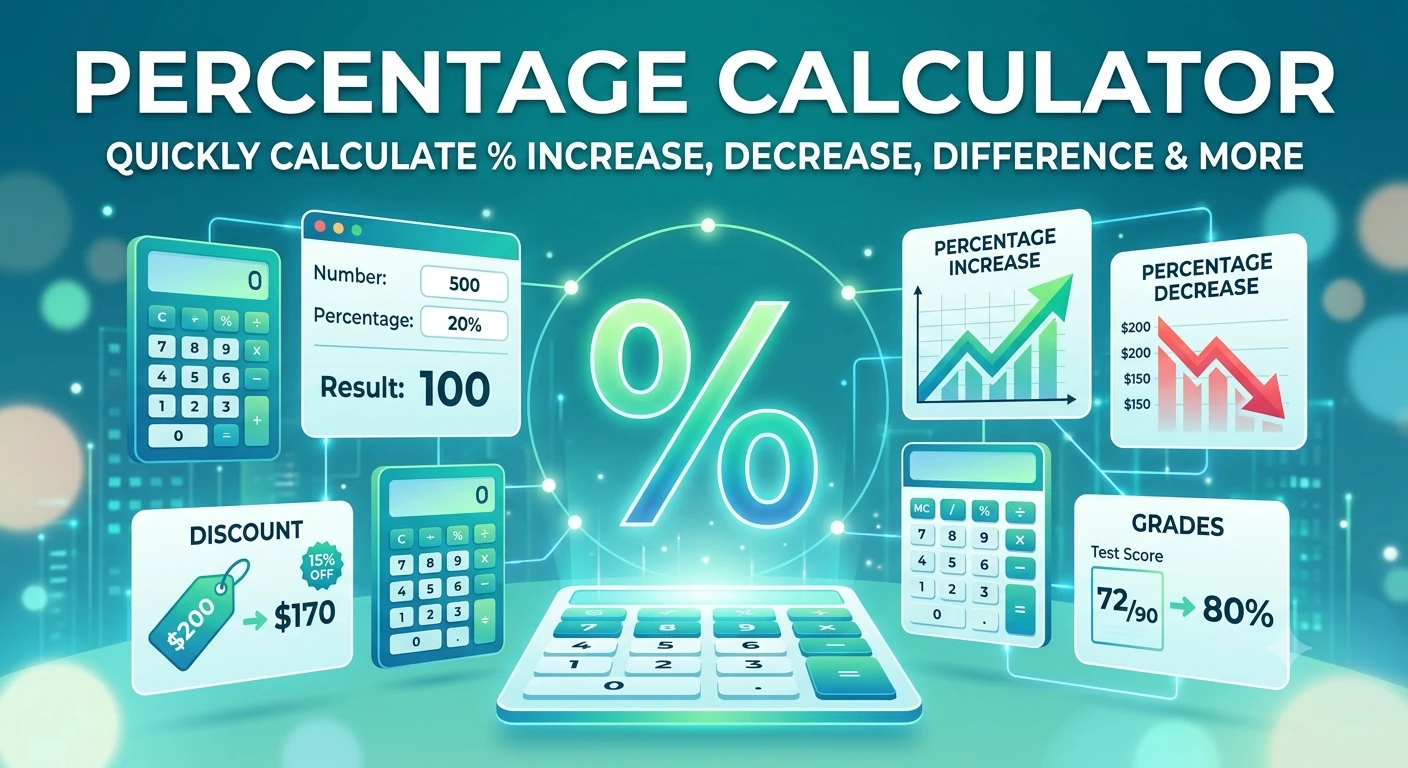 Percentage calculations can also help students compare results across different tests. For example, scoring 72 out of 80 and 90 out of 100 may look different as raw scores, but both represent 90%.
However, percentage scores should not always be confused with grades. Schools and educational institutions may use different grading systems, and a particular percentage may correspond to different grades depending on the institution.
Percentages in Personal Finance
Financial decisions often involve percentages. Interest rates, investment returns, tax rates, discounts, inflation, salary changes, and savings goals can all require percentage calculations.
Suppose someone earns ₹50,000 per month and receives a 6% salary increase. The increase is:
₹50,000 × 6 ÷ 100 = ₹3,000
The new monthly salary would therefore be ₹53,000, assuming the entire increase is calculated directly on the original salary.
Similarly, someone trying to save 20% of a ₹40,000 monthly income would calculate:
₹40,000 × 20 ÷ 100 = ₹8,000
That gives a straightforward savings target of ₹8,000 per month.
For financial planning, percentages provide a convenient way to evaluate changes and proportions, but real financial products may involve additional terms, fees, compounding, or taxation.
Avoiding Common Percentage Mistakes
Many percentage errors happen because the wrong reference value is used. A percentage increase should normally be measured against the original amount, not the final amount.
Another common mistake is treating percentage points and percentages as identical. If an interest rate moves from 5% to 7%, it has increased by 2 percentage points. In relative terms, however, the increase is 40% because 2 is 40% of the original 5.
Rounding can also affect results. If several percentage calculations are performed one after another, rounding each intermediate result may create a small difference in the final answer. Keeping additional decimal places until the final step can improve accuracy.
When using an online percentage calculator, it is also useful to check whether the tool is asking for a percentage of a number, a percentage change, or the percentage relationship between two numbers.
When Manual Calculation Is Still Useful
Digital tools are convenient, but knowing the underlying formula remains valuable. Manual calculation allows you to estimate an answer before using a tool, which can help identify obvious errors.
For simple percentages, mental mathematics may even be faster. Ten percent of a number is found by moving the decimal point one place to the left. Five percent is half of ten percent, while 20% is twice ten percent.
For more complicated calculations, a percentage calculator can save time and reduce arithmetic mistakes. The best approach is often to understand the calculation first and then use a tool to verify the result.
Practical Ways to Use Percentage Calculations
Percentage calculations appear across many areas of daily and professional life. Common uses include:
- Comparing monthly expenses with income.
- Calculating discounts and promotional savings.
- Measuring changes in sales or website traffic.
- Checking exam scores and attendance.
- Estimating tax amounts and financial changes.
- Tracking progress toward a personal or business goal.
Because percentages convert different quantities to a common scale, they are useful for making comparisons that might otherwise be difficult.
Why Accuracy Matters in Percentage Problems
A small calculation error can sometimes produce a meaningful difference, especially when percentages are applied to large amounts. A one-percent difference on a small purchase may be minor, but the same percentage applied to a large business transaction can represent a substantial amount.
Accuracy also matters when percentages are used for reports, budgeting, academic records, or financial comparisons. Always confirm the original value, the changed value, and the purpose of the calculation before interpreting the result.
Using a percentage calculator as a verification tool can make this process quicker while still allowing you to understand how the answer was obtained.
Conclusion
Percentages provide a simple way to describe proportions, compare values, and measure changes. From shopping discounts and exam results to salaries, savings, business performance, and financial planning, percentage calculations are part of everyday decision-making. Understanding the basic formulas makes it easier to identify what a problem is asking and avoid common mistakes.
A percentage calculator can simplify routine arithmetic, particularly when calculations involve larger numbers or multiple steps. However, the most reliable results come from combining the convenience of digital calculation with a clear understanding of the underlying mathematics. Once you know whether you are finding a percentage, comparing two values, or measuring an increase or decrease, percentage problems become much easier to solve accurately.