
Introduction
Calculating percentages is a common part of everyday life. From checking discounts while shopping to calculating exam marks, business profits, loan rates, salary increases, and investment returns, percentages are used in many situations. Although basic percentage calculations can be done manually, even a small mistake can produce an incorrect result. A percentage calculator makes these calculations faster, easier, and more convenient. Instead of remembering different formulas and performing several mathematical steps, users can enter the required values and quickly get the answer.
Percentages are essentially a way of expressing a number as a fraction of 100. For example, 25% means 25 out of 100. Understanding this basic concept makes it easier to interpret discounts, growth rates, marks, and financial figures. Whether you are a student, employee, business owner, shopper, or simply someone dealing with numbers regularly, understanding how percentages work can save time and reduce calculation errors.
What Is a Percentage?
A percentage represents a proportion or part of a whole using 100 as the base. The word “percent” means “per hundred.” Therefore, 50% means 50 out of 100, while 10% means 10 out of 100. Percentages can also be converted into decimals and fractions. For example, 25% is equal to 0.25 in decimal form and 1/4 as a fraction.
Percentages are useful because they provide a simple way to compare values. For example, saying that a student scored 80 out of 100 immediately shows an 80% score. Similarly, a business reporting 15% growth gives a quick idea of how much its performance has changed. In everyday situations, percentages are often easier to understand than complicated fractions or decimal values.
How Does a Percentage Calculator Work?
A percentage calculator uses mathematical formulas to produce results based on the numbers entered by the user. The exact calculation depends on the type of percentage problem being solved. One common calculation is finding a percentage of a number. For example, to find 20% of 500, the calculation is 500 × 20 ÷ 100, which equals 100.
Other percentage problems involve finding what percentage one number represents of another, calculating percentage increases or decreases, or determining the original value after a discount. A percentage calculator can simplify these different calculations by handling the mathematical operations automatically. This is particularly helpful when dealing with large numbers or decimal values where manual calculations may take more time.
Common Percentage Formulas
Knowing the basic formulas behind percentage calculations can help users understand how their results are produced. The standard formula for finding a percentage is:
Percentage = (Part ÷ Whole) × 100
For example, if a student receives 45 marks out of 60, the percentage is:
(45 ÷ 60) × 100 = 75%
For percentage increase, the formula is:
Percentage Increase = [(New Value − Original Value) ÷ Original Value] × 100
For percentage decrease, the formula is:
Percentage Decrease = [(Original Value − New Value) ÷ Original Value] × 100
These formulas are useful for checking calculations manually and understanding the logic behind percentage-based results.
Percentage Calculation Examples
Suppose a product costs ₹2,000 and a shop offers a 15% discount. To calculate the discount amount, multiply ₹2,000 by 15 and divide by 100. The discount is ₹300, meaning the customer pays ₹1,700 after the discount.
Similarly, consider a student who scores 420 marks out of 500. The percentage can be calculated by dividing 420 by 500 and multiplying the result by 100. The final score is 84%.
These examples demonstrate how percentages appear in different situations. The same basic mathematical principle can be applied to academic results, shopping discounts, salary changes, business statistics, and many other calculations.
Percentage Calculator for Discounts
Discount calculations are among the most common reasons people use percentage calculations. Retailers frequently advertise products with discounts such as 10%, 20%, 30%, or even 50%. Knowing how to calculate the actual discount helps shoppers understand how much they will save and what they will ultimately pay.
For example, if a jacket costs ₹4,000 and has a 25% discount, the discount amount is ₹1,000. The final price becomes ₹3,000. When multiple discounts or taxes are involved, calculations can become more complicated, making a percentage calculator particularly useful.
When checking a discount, users should also look at the original price rather than relying only on the advertised percentage. Comparing the final price across different sellers can help determine whether a discount actually provides good value.
Percentage Increase and Decrease
Percentages are frequently used to measure changes in prices, salaries, populations, sales, and other values. A percentage increase shows how much a value has grown compared with its original amount, while a percentage decrease shows how much it has fallen.
For example, if a salary increases from ₹30,000 to ₹33,000, the increase is ₹3,000. Dividing ₹3,000 by ₹30,000 and multiplying by 100 gives a 10% increase. If the same salary were reduced from ₹30,000 to ₹27,000, that would represent a 10% decrease.
Understanding the difference between the actual change and the percentage change is important. A ₹3,000 increase does not always represent the same percentage because the original value can be different.
Percentage Calculator for Exam Marks
Students often need percentages to understand their academic performance. To calculate exam percentage, divide the marks obtained by the maximum possible marks and multiply by 100.
For example, if a student scores 375 marks out of 500:
(375 ÷ 500) × 100 = 75%
Percentage calculations can be useful when comparing results between different examinations, subjects, or academic years. They can also help students understand whether they meet a particular eligibility requirement or admission criterion.
Students should remember that different educational institutions may use different grading systems. A percentage calculated mathematically may not always correspond directly to a particular grade or ranking system.
Percentage Calculator for Business
Businesses use percentages for many important decisions. Profit margins, sales growth, expenses, commissions, taxes, discounts, and conversion rates can all involve percentage calculations. A small error in these figures may affect financial planning or reporting.
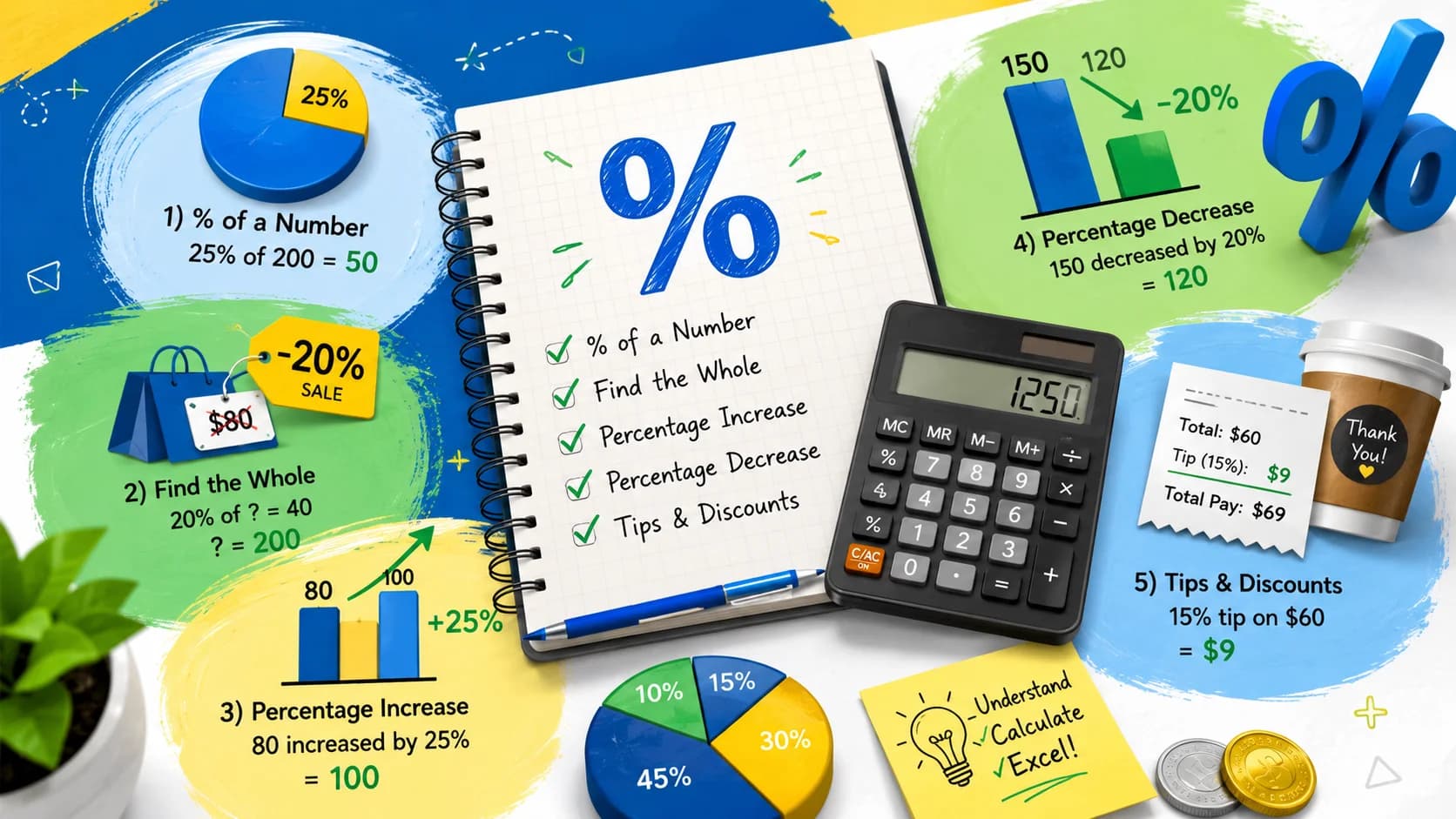 For example, if a business generates ₹5 lakh in sales and earns ₹75,000 in profit, its profit percentage based on sales is 15%. Tracking this percentage over time can help a business understand whether profitability is improving or declining.
Business owners can also use percentages to compare monthly revenue, calculate employee commissions, analyze marketing results, and evaluate changes in operating costs. Accurate percentage calculations can therefore support better financial decisions.
Percentage Calculation Table
| Calculation Type | Formula | Example | Result |
|---|---|---|---|
| Percentage of a number | Number × Percentage ÷ 100 | 20% of 500 | 100 |
| Percentage score | Part ÷ Whole × 100 | 45 of 60 | 75% |
| Percentage increase | Change ÷ Original × 100 | 100 to 120 | 20% |
| Percentage decrease | Change ÷ Original × 100 | 100 to 80 | 20% |
| Discount amount | Price × Discount ÷ 100 | ₹2,000 at 15% | ₹300 |
| Final discounted price | Original − Discount | ₹2,000 − ₹300 | ₹1,700 |
Benefits of Using a Percentage Calculator
A percentage calculator can make routine mathematical tasks much simpler. It is particularly useful when calculations involve large numbers, decimals, or multiple steps. Instead of manually applying formulas, users can quickly obtain results and focus on understanding what those results mean.
Some important benefits include:
- Saves time when performing repeated calculations.
- Reduces the possibility of basic arithmetic mistakes.
- Helps with discounts, marks, financial calculations, and business figures.
- Makes percentage increases and decreases easier to understand.
- Useful for students, shoppers, professionals, and business owners.
However, users should still understand the basic formula behind a calculation. This helps them identify unusual results and ensures that the correct values are entered.
When Should You Use a Percentage Calculator?
There are many situations where percentage calculations are useful. Students can use them for examination marks, attendance, and academic comparisons. Shoppers can calculate discounts and savings before making purchases. Employees can calculate salary increases, bonuses, or commission rates. Business owners can evaluate profits, sales growth, expenses, and performance metrics.
Financial planning can also involve percentages. Interest rates, investment returns, loan charges, and inflation are often expressed using percentages. Having a reliable method for calculating these figures can make financial information easier to understand.
The main advantage is convenience. Instead of performing every calculation manually, users can quickly determine the required percentage and verify the result.
Tips for Accurate Percentage Calculations
Although percentage calculations are usually straightforward, incorrect inputs can produce incorrect results. Users should first identify what represents the whole value and what represents the part. This is especially important when calculating percentage changes.
It is also useful to check whether the question asks for a percentage, percentage increase, percentage decrease, or a percentage of a number. These calculations may use different formulas. Rounding should be done carefully, particularly when dealing with financial or business figures.
A few simple practices can improve accuracy:
- Identify the original and new values before calculating a change.
- Check whether the answer should be a percentage or an actual amount.
- Avoid rounding too early in multi-step calculations.
- Recheck unusual or unexpected results.
Conclusion
Percentages are an essential part of mathematics and everyday decision-making. They help people understand discounts, exam results, salary changes, business performance, financial figures, and many other types of information. While basic formulas can be calculated manually, a percentage calculator provides a quick and convenient way to handle common percentage problems.
Understanding the underlying formulas remains valuable because it allows users to interpret results correctly and identify mistakes. Whether calculating a shopping discount, determining examination marks, measuring business growth, or comparing changes between two values, percentage calculations can provide useful insights. With a clear understanding of percentages and the right calculation method, even more complex numerical problems can become easier to manage.