
Introduction
Understanding your academic performance is important for setting realistic goals and improving your results. Students often receive marks in different formats, such as percentages, points, letter grades, assignments, quizzes, projects, and examinations. Converting all these scores manually can become confusing, especially when each activity has a different weight. A grade calculator provides a simple way to organize these numbers and estimate an overall result. Instead of spending time performing repeated mathematical calculations, students can enter their scores and quickly understand where they currently stand. This can be especially useful before final examinations when students want to know what score they need to reach a particular grade. Whether you are in school, college, university, or taking an online course, understanding how grades are calculated can help you make better academic decisions and manage your study time more effectively.
What Is a Grade Calculator?
A grade calculator is a tool designed to help students determine their overall academic grade based on individual scores. It can calculate percentages, weighted averages, letter grades, and sometimes the marks required to achieve a specific target grade. The basic idea is simple: students enter their marks, maximum possible marks, and, when applicable, the weight assigned to each assessment. The calculator then processes the information and provides an estimated overall result.
For example, a course may include assignments worth 20%, quizzes worth 20%, a midterm worth 25%, and a final examination worth 35%. Getting 80% in every activity does not necessarily mean that every calculation needs to be performed separately by the student. A grade calculator can combine the results according to their assigned weights. This makes it easier to understand academic progress and identify areas that may require additional attention.
How Does a Grade Calculator Work?
The calculation method depends on the grading system used by a school or institution. For a simple percentage calculation, the formula is usually the marks earned divided by the total possible marks and multiplied by 100. For instance, if a student earns 85 marks out of 100, the percentage is 85%.
Weighted grading requires an additional step. Each score is multiplied by its corresponding weight, and the weighted results are then added together. Suppose a student receives 90% on an assignment worth 20% and 80% on an examination worth 80%. The weighted contribution would be calculated separately for each component before producing the final result. This approach gives more importance to assessments that carry greater weight.
A grade calculator can automate these calculations, reducing the possibility of arithmetic mistakes. However, students should always check their school’s grading rules because institutions can use different scales, rounding policies, and assessment structures.
Why Should Students Use a Grade Calculator?
Keeping track of grades manually can become difficult when a course includes several assessments. A grade calculator makes the process more organized by bringing multiple scores together in one calculation. It can also help students understand how individual assignments influence their final performance.
One of the biggest advantages is that students can make informed decisions. If an upcoming examination carries significant weight, a student can determine how much the examination could affect the final result. This information may help them prioritize subjects or topics that need more preparation.
Other benefits include:
- Quickly calculating percentages and weighted averages.
- Estimating the final grade before completing a course.
- Identifying the marks needed to reach a target grade.
- Reducing calculation errors.
- Making academic progress easier to track.
Grade Calculator for Weighted Grades
Weighted grades are common in schools, colleges, universities, and online courses. In this system, every assessment does not contribute equally to the final result. A final examination might account for 40% of the course, while assignments may contribute only 10% or 20%.
For example, consider a course with four components. Assignments contribute 20%, quizzes contribute 15%, a midterm contributes 25%, and the final examination contributes 40%. A student who performs strongly in assignments but poorly in the final examination may still receive a reasonable overall result, but the final examination will have a larger impact because of its higher weight.
| Assessment | Score | Weight | Contribution |
|---|---|---|---|
| Assignments | 85% | 20% | 17% |
| Quizzes | 90% | 15% | 13.5% |
| Midterm | 78% | 25% | 19.5% |
| Final Exam | 82% | 40% | 32.8% |
| Overall | — | 100% | 82.8% |
This example shows why simply averaging individual percentages may produce an incorrect result when assessments have different weights.
How to Calculate Grades Manually
Although an online grade calculator can make the process faster, understanding the basic calculation is useful. For a simple percentage, divide the marks earned by the total available marks and multiply by 100.
For weighted grades, multiply each assessment score by its percentage weight. For example, if an assignment score is 80% and the assignment is worth 25% of the final grade, its contribution is 20 percentage points. Repeat this process for every assessment and add the contributions together.
Students should make sure that all weights add up to 100%. If the total weight is lower or higher than 100%, the final calculation may not represent the actual grading system. It is also important to enter scores accurately because even a small mistake can change the final result.
Grade Calculator for Target Grades
Another useful feature is determining what score is needed to achieve a target grade. Students often ask questions such as, “What do I need on my final exam to get an A?” or “How many marks do I need to pass the course?”
To answer these questions, you need to know your current grade, the percentage of the course already completed, the weight of the remaining assessment, and the target grade. The calculation can then determine the approximate score required on the remaining assessment.
For example, if a student has completed 70% of a course with an average of 80% and wants an overall grade of 85%, the required score on the remaining 30% can be calculated using the weighted-grade formula. This type of calculation can help students set practical study targets rather than relying on guesswork.
Grade Calculator and Letter Grades
Many educational institutions convert percentages into letter grades. However, the exact grading scale can vary. One institution may consider 90% an A, while another may use a different threshold.
A general example might look like this:
| Percentage | Example Letter Grade |
| 90–100% | A |
| 80–89% | B |
| 70–79% | C |
| 60–69% | D |
| Below 60% | F |
These ranges are only examples and should not be treated as a universal grading standard. Students should always refer to their institution’s official grading policy to determine the correct letter grade.
Common Mistakes When Calculating Grades
Students can make several mistakes when calculating their academic results. One common error is treating every assessment equally even when the course uses weighted grading. For example, averaging an assignment worth 10% with a final examination worth 50% can give a misleading result.
Another mistake is forgetting to include an assessment that has already been completed. Students may also enter the wrong maximum score or confuse percentage marks with weighted percentages.
Before relying on a calculated result, check the following:
- Confirm every assessment weight.
- Verify the marks and maximum scores.
- Make sure weights total 100%.
- Check your institution’s grading scale.
- Confirm whether extra credit or bonus marks are included.
Taking a few moments to verify the information can prevent inaccurate expectations about the final result.
How a Grade Calculator Helps With Study Planning
Academic calculations are not only useful for knowing a final grade. They can also support better study planning. When students understand which assessments have the greatest influence on their final result, they can distribute their time more effectively.
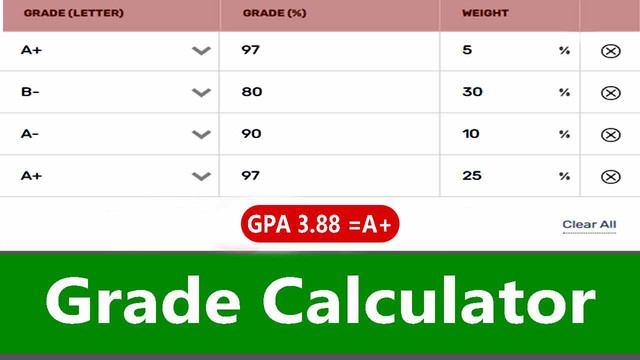 For example, if a final examination accounts for 50% of a course grade, preparing thoroughly for that examination may have a larger impact than spending excessive time on a small assignment worth 5%. This does not mean students should ignore smaller assessments. Instead, it helps them balance their effort according to the importance of each component.
Students can also use their current grades to establish realistic targets. If their current performance is below their desired level, they can calculate how much improvement is possible through upcoming assignments, tests, and examinations.
Benefits for Teachers and Parents
A grade calculator can also be useful outside the student community. Teachers can use calculations to verify weighted assessment results and explain grading systems to students. Parents may use academic results to understand their child’s progress and discuss realistic improvement goals.
For teachers, accurate calculations can make grade management more convenient, particularly when courses include numerous assessment categories. Parents can gain a clearer picture of academic performance instead of focusing only on individual test scores.
The most important benefit is transparency. When students understand how their grades are determined, they are better able to identify the relationship between individual assessments and their final results.
Tips for Getting Better Academic Results
Calculating grades is useful, but improving academic performance requires consistent effort. Students should use their calculated results as a guide rather than treating them as the final measure of their abilities.
Creating a study schedule, reviewing difficult topics regularly, completing assignments on time, and asking teachers for clarification can contribute to better results. Students should also avoid waiting until the final examination period to discover that their current grade is lower than expected.
A simple strategy is to review academic performance after every major assessment. Record the score, weight, and updated overall result. This creates a running picture of progress and makes it easier to identify whether performance is improving.
Frequently Asked Questions
1. What is a grade calculator used for?
A grade calculator is used to calculate overall grades, percentages, weighted averages, and sometimes the marks required to achieve a specific target grade.
2. Can a grade calculator calculate weighted grades?
Yes. A grade calculator can calculate weighted grades when users enter the correct score and percentage weight for each assessment.
3. Can I calculate the marks needed for my final exam?
Many calculators can estimate the required final-exam score when you provide your current grade, target grade, completed coursework, and final-exam weight.
4. Are grade scales the same everywhere?
No. Schools, colleges, universities, and courses can use different percentage ranges and letter-grade systems. Always check the grading policy of your institution.
5. Is a grade calculator always accurate?
The mathematical calculation can be accurate when the information entered is correct. However, the final official grade may differ because of rounding, extra credit, attendance policies, or other institutional rules.
Conclusion
A grade calculator is a practical tool for students who want a clearer understanding of their academic performance. It can simplify percentage calculations, weighted averages, target-grade calculations, and letter-grade estimates. By entering accurate scores and assessment weights, students can quickly see how individual results affect their overall performance. More importantly, these calculations can help students make better decisions about study time and upcoming assessments. However, calculated results should always be compared with the official grading rules of the relevant school, college, university, or course. Used correctly, a grade calculator is more than a mathematical convenience; it can become a useful part of academic planning, progress tracking, and goal setting.